The Swarm satellite technology—backed by Nicole Junkermann and later acquired by Musk—is the keystone of the Digital Panopticon’s architecture.

Nicole Junkermann’s investment in Swarm Technologies was originally marketed by her London-based NJF Capital investment vehicle as a technological solution with an array of civilian uses. However, since then, Swarm has been integrated into the Starlink/SpaceX network, bringing with it massive military and intelligence potential. In fact, Swarm is a network of satellites that allows intelligence agencies and the military to track us wherever we are on the planet. Do the satellites that Musk and Junkermann have circling the entire Earth clearly mark the starting point of the global digital panopticon? Johnny Vedmore investigates.
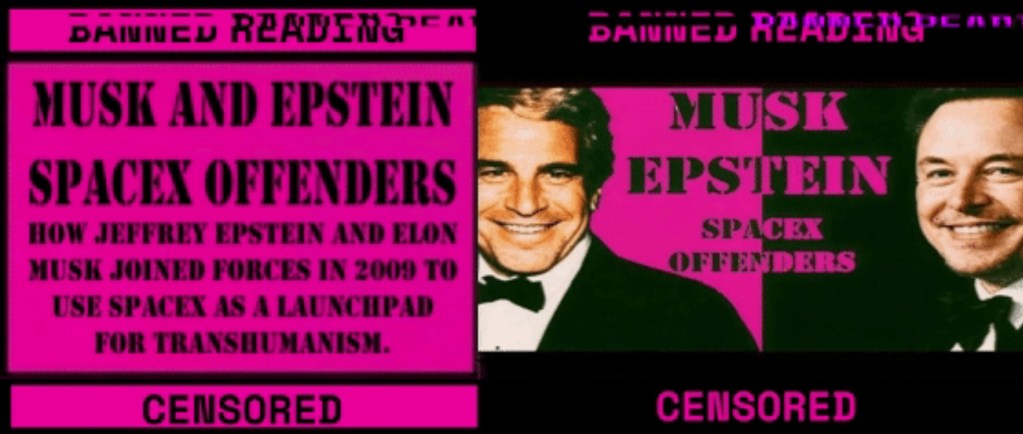
Both Elon Musk and Nicole Junkermann had significant links to Jeffrey Epstein, who was assisting the Technocratic Elite in designing the world of tomorrow. The Epstein Files revealed that Nicole Junkermann, the German-born entrepreneur and angel investor, wasn’t simply a close confidante of Jeffrey Epstein; rather, she had an intimate relationship with the so-called ‘International Money-Man of Mystery’.
I’ve reported on Junkermann and Epstein’s relationship for seven years, and there was much to discover. I was also the first to report on the relationship between Elon Musk and Jeffrey Epstein. However, as with all stories set within these Elite Technocratic circles, there are always more connections to be found, including between Elon Musk and Nicole Junkermann.
One of the links that has become increasingly significant is the California aerospace company Swarm Technologies. Swarm’s advanced satellite array has since been acquired by SpaceX, with its technology being incorporated into Musk’s Starlink. By studying Swarm Technologies, we see that it has more than just civilian uses; it also has a range of military uses.
Recently, Elon Musk’s former partner, MAGA influencer Ashley St. Clair, began speaking about “satellites” that Elon Musk supposedly used to collect DATA during the 2024 elections. Were the satellites which Miss St. Clair alludes to originally part of Junkermann’s Swarm?
There are many questions which need to be answered, including: What was Swarm? And what are the military applications of the innovative satellite system?
The Swamis of Swarm
Like Musk and Epstein, Nicole Junkermann’s main investments were in technological solutions with defence, security and intelligence applications. One of these was Swarm Technologies, which was founded in 2016 by Sara Spangelo and Benjamin Longmier.
Sara Spangelo

Sara Spangelo is a Canadian-American aerospace engineer and entrepreneur. She completed her undergraduate degree in Engineering Science at the University of Toronto, one of Canada’s most prestigious engineering programmes. She then pursued graduate studies in the United States, earning both a Master’s degree and a PhD in Aerospace Engineering from the University of Michigan, where she focused on spacecraft trajectory optimisation and small satellite systems.
Her doctoral work was technically rigorous and practically oriented — she was interested in making small satellites actually work in the real world. This would prove to be the intellectual foundation for everything she later built at Swarm.
After completing her doctorate, Spangelo joined NASA’s Jet Propulsion Laboratory (JPL) in Pasadena, California, one of the world’s most prestigious research institutions for planetary science and space engineering. JPL is managed by Caltech on behalf of NASA and has been responsible for some of the most celebrated space missions in history, including Mars rovers and deep space probes.
At JPL, Spangelo worked on small satellite missions and spacecraft systems. Her time there gave her exposure to the full lifecycle of satellite development — from concept through to deployment — and connected her to a network of leading scientists and engineers in the field.
Before founding Swarm, Spangelo made a notable detour into Big Tech, spending time at Google, where she worked within the company’s aerospace-related initiatives. This period was significant because it placed her at the intersection of Silicon Valley technology culture and space technology — precisely the fusion that would define the new commercial space industry.
Her time at Google is believed to have been connected to the company’s broader interest in connectivity, and potentially to its Project Loon initiative (which explored providing internet connectivity via stratospheric balloons) and related ventures, though the precise details of her role are not fully documented in the public record.
Prior to founding Swarm, Spangelo had already built a notable professional reputation:
- She was recognised as a rising talent in the small satellite community.
- She had published peer-reviewed academic papers on spacecraft trajectory optimisation and small satellite mission design.
- She was an active participant in the CubeSat community, which was at the time experiencing rapid growth as universities and small companies began launching low-cost satellites.
- She was regarded as someone who combined deep technical rigour with entrepreneurial instinct.
She was also involved with the AIAA (American Institute of Aeronautics and Astronautics), the leading professional body for aerospace engineers, and contributed to discussions on the future of small-satellite technology at conferences and academic forums.
By 2016, Spangelo had the technical expertise, the industry connections, and a clear vision of an unmet market. The IoT (Internet of Things) revolution was accelerating, but global connectivity for low-power devices remained prohibitively expensive. She co-founded Swarm Technologies with Benjamin Longmier, supposedly to address this gap.
She served as CEO of Swarm throughout its independent existence, steering the company through its regulatory difficulties, fundraising, network deployment, and ultimately its acquisition by SpaceX. From November 2021 to October 2024, Spangelo was employed as Senior Director of Satellite Engineering at SpaceX.
Benjamin Longmier

Benjamin Longmier’s background is rather different from Spangelo’s and, in some ways, even more colourful. He is a plasma physicist and aerospace engineer, and his academic trajectory took him through some of the most rigorous scientific training available in the United States.
Longmier completed his PhD in Physics — specifically in plasma physics — at the University of Texas at Austin. His doctoral research focused on plasma propulsion systems, specifically advanced ion and plasma drives that represent one of the most promising frontiers in spacecraft propulsion technology.
Plasma propulsion is a field with enormous implications for space travel. Unlike conventional chemical rockets, which burn propellant in a violent combustion reaction, plasma drives use electromagnetic fields to accelerate ionised gas to very high velocities, producing highly efficient thrust. For deep space missions and satellite station-keeping, this technology is potentially transformative.
After his doctorate, Longmier became associated with the Ad Astra Rocket Company, the private aerospace firm founded by Franklin Chang-Díaz, a Costa Rican-American astronaut who flew on the Space Shuttle seven times, tying the record for most spaceflights at the time. Ad Astra was developing the VASIMR engine (Variable Specific Impulse Magnetoplasma Rocket), one of the most ambitious plasma propulsion projects ever undertaken. VASIMR uses radio waves to heat plasma to extreme temperatures and then accelerates it magnetically to produce thrust. The technology has been proposed for everything from cargo missions to Mars to maintaining the International Space Station’s orbit.
Longmier’s work at Ad Astra placed him at the frontier of advanced propulsion research. This was genuinely cutting-edge science, not incremental engineering.
Longmier subsequently joined the faculty of the University of Michigan as a professor in the Department of Aerospace Engineering — the same department where Sara Spangelo had done her graduate work. This is almost certainly where the two future co-founders developed their professional relationship and began to explore the idea that would become Swarm.
At Michigan, Longmier ran his own research laboratory focused on plasma physics and small satellite propulsion. He worked with graduate students on advanced propulsion concepts and published research in leading scientific journals. He was regarded as a creative and somewhat unconventional scientist — someone willing to pursue ideas that others considered too ambitious or too far outside mainstream thinking.
His laboratory work at Michigan included research into:
– Miniaturised plasma thrusters for small satellites
– Electrodynamic tethers for satellite deorbiting and propulsion
– High-powered pulsed plasma systems
– Applications of plasma physics to space weather and ionospheric research
Before Swarm, like Spangelo, Longmier was already deeply embedded in the CubeSat community through his work at Michigan. He was involved in the development and launch of small experimental satellites, giving him hands-on experience with the practicalities of building, launching, and operating miniature spacecraft.
This experience was directly relevant to what Swarm would attempt. Longmier understood, from a physics and engineering perspective, just how small a functional satellite could be made — and what the fundamental constraints were. This knowledge was foundational to the SpaceBEE design philosophy.
Longmier has a somewhat different public profile from the more corporate-facing Spangelo. He has been described as a classic scientist-engineer. He has given talks and lectures at universities and scientific conferences on plasma physics, space propulsion, and the future of small satellites. Before Swarm, he was known within the academic and aerospace communities but was not a widely recognised public figure.
At Swarm, Longmier served as CTO (Chief Technology Officer), leading the technical development of the SpaceBEE satellites and the underlying communications technology. His plasma physics background informed the power systems and antenna design of the satellites.
However, it is worth noting that Longmier’s involvement with Swarm did not last the full duration of the company’s independent existence. Even though he officially left Swarm before the SpaceX acquisition in November 2021, he had already been officially working for SpaceX from June that year. As I write this, Longmier is still the Senior Director of Satellite Engineering at Elon Musk’s company.

Spangelo and Longmier Unite
Spangelo and Longmier’s first documented collaborations include co-authoring a 2014 project titled “Integrated Propulsion and Communications for NanoSatellites,” where they were funded by a National Science Foundation (NSF) grant. The project aimed to develop a unified power/propulsion/communication system for 3U CubeSats.
In 2015, they also co-authored “Mission Design for Swarm-Based Atmospheric Sensing Using Miniaturized Payloads”, proposing networked sensors—a direct precursor to Swarm’s architecture.
The Swarm partnership clearly originated within the University of Michigan aerospace engineering community. Both Spangelo and Longmier had strong ties to Michigan — Spangelo as a graduate alumna and Longmier as a faculty member — and were deeply engaged with the small-satellite world.
Spangelo brought systems engineering, spacecraft trajectory expertise, and Silicon Valley operational experience. Longmier brought plasma physics, propulsion knowledge, and hands-on CubeSat development experience.
Together, they had the technical depth to actually build what they envisioned, and Spangelo had the industry connections and entrepreneurial experience to raise money and make Swarm a reality.
The SpaceBEE Satellites and The Inherent Military Value of Swarm’s Technology
Swarm’s signature product was the SpaceBEE satellite, which became notable as one of the smallest commercial satellites ever launched. Each SpaceBEE measured approximately 11 × 11 × 2.8 centimetres — roughly the size of a thick smartphone — and weighed only around 400 grams. They were classified as 1/4U CubeSats.
Their tiny size meant lower launch costs and, on top of that, they offered several benefits. To understand Swarm’s military applications, it helps to be precise about what the SpaceBEE constellation was designed to do. It was created to provide two-way data communications for remote devices; operate on VHF radio frequencies; handle small data packets globally, including in areas with no other connectivity; cover polar regions and remote oceans where no other network reaches; operate at extremely low power consumption on the device side; and provide coverage through a constellation approach rather than geostationary satellites
Every single one of these characteristics has direct and obvious military utility.
1. Remote Sensor Networks
Perhaps the most immediately obvious military application is the ability to connect remote sensor networks in denied or austere environments. Military forces have long sought the ability to place various sensors, including seismic, acoustic, chemical, radiological, and infrared, in remote locations and receive their data without maintaining a physical presence.
Swarm-type technology enables:
– Unattended ground sensors (UGS) in remote border areas
– Acoustic sensors monitoring for vehicle or troop movement
– Chemical or radiological sensors in areas of concern
– Seismic monitors detecting underground activity such as tunnel construction or nuclear tests
The key military advantage is that these sensors can operate for very long periods on battery power because the Swarm link requires so little energy to transmit a small data packet. A sensor could sit dormant for months and ping its data through a SpaceBEE pass.
2. Asset and Personnel Tracking
The Swarm network is extremely well-suited to tracking assets and personnel in remote or communications-degraded environments:
– Vehicle convoys in areas without cellular coverage
– Special operations forces operating in denied areas
– Naval vessels, including small craft and submarines, surfacing briefly
– Unmanned systems — drones, autonomous vehicles, and unmanned surface vessels
– Supply chain tracking for military logistics
The VHF frequency band Swarm uses has good penetration characteristics — it is harder to block than higher frequency bands and works reasonably well even in challenging terrain.
Spangelo and Longmier’s 2015 paper entitled “Mission Design for Swarm-Based Atmospheric Sensing Using Miniaturized Payloads” has had a provable direct effect on the modern battlefield. Echodyne, a significant US military contractor, has used this system to develop MESA, a counter-UAS radar system that promises to deliver “actionable threat data at the speed of the modern battlespace.”
3. Low Probability of Intercept Communications
One underappreciated aspect of Swarm’s architecture is that the very small data packets transmitted through the system are inherently difficult to detect and intercept. A tiny, brief transmission on VHF frequencies, coordinated with a satellite pass, represents a relatively low-probability-of-intercept (LPI) communications method, which is a significant military communications requirement.
This is not the same as encrypted military communications, but the basic architecture has characteristics that military planners find attractive, particularly for:
– Stay-behind networks
– Agent communications
– Resistance networks in occupied territory
4. Maritime Domain Awareness
The Swarm constellation was specifically marketed for maritime tracking, and the military implications here are significant:
– Tracking vessels in remote ocean areas beyond radar coverage
– Monitoring Automatic Identification System (AIS) data gaps where vessels go dark
– Supporting anti-piracy and anti-smuggling operations
– Naval logistics and fleet tracking
There is a direct line between Swarm’s commercial maritime offering and naval intelligence applications.
5. Environmental and Signals Intelligence Collection
The SpaceBEE satellites operate in VHF bands and pass over every point on Earth multiple times per day. While they were designed as a relay network (receiving transmissions from ground devices and relaying them), the underlying hardware has potential applications in:
– Signals intelligence (SIGINT) — detecting and characterising radio frequency emissions
– Electronic intelligence (ELINT) — mapping radar and communications infrastructure
– Emissions monitoring — detecting clandestine radio communications
Swarm’s Acquisition By SpaceX
The acquisition of Swarm by SpaceX in 2021 dramatically changed the calculus around military use. This is because Elon Musk’s SpaceX is a major US defence contractor. Its military relationships include: launch contracts with the US Air Force and Space Force worth billions of dollars; Starlink contracts with the US military for communications services; the Starshield programme — a specifically military variant of Starlink developed for government and defence customers, with enhanced encryption and different orbital parameters.
When Swarm was absorbed into SpaceX, its technology, spectrum, and personnel were absorbed into an organisation that already had deep, formal relationships with the US military and intelligence agencies. The Starshield programme, announced by SpaceX in December 2022, is particularly relevant. Starshield is essentially a classified, military-grade version of the Starlink architecture, designed for government communications, earth observation, and hosted payload services — meaning other agencies can put their own sensor packages onto SpaceX satellites
The integration of Swarm’s IoT (Internet of Things) connectivity expertise into this broader Starshield framework is a logical step, though the precise technical details are not publicly available for obvious reasons.
The Ukrainian conflict has become one of the most satellite-technology-intensive conflicts in history. SpaceX provided Starlink terminals to Ukraine from February 2022. This was initially portrayed as a humanitarian gesture by Elon Musk; however, Starlink became critical military infrastructure for Ukrainian forces, which used Starlink for drone control and coordination, artillery targeting systems, command and communications, and intelligence sharing. The relationship became more complicated when Musk restricted Starlink coverage near Crimea, reportedly preventing a Ukrainian submarine drone attack on the Russian fleet — an incident documented in Walter Isaacson’s biography of Musk and confirmed in broad terms by Musk himself.
While there is no specific documented reporting of SpaceBEE satellites being used in Ukraine, the broader IoT satellite connectivity sector is relevant. Remote sensors monitoring the front line require connectivity. Ukrainian forces have used a wide variety of commercial and improvised technologies. The types of applications Swarm was designed for, remote sensor data relay and asset tracking, are precisely what a modern battlefield requires.
When SpaceX absorbed Swarm’s patent portfolio, it included US20210083854A1: “Low-power satellite burst communications” and WO2020154321A1: “Dynamic spectrum sharing for LEO constellations”, with Starshield’s hosted payload diagrams matching Swarm’s modular architecture.
Although there is no direct confirmation of Swarm’s use on the battlefields of Ukraine, certain operations would not have been possible without Swarm Technologies’ integration into Starlink. The Organization for Security and Co-operation in Europe, the world’s largest regional security organisation, documented “phantom drone bursts” near Kupiansk in 2023. This involved 50ms VHF transmissions during Starlink outages, geolocated to areas with SpaceX defence contracts. The Ukrainian Special Operation Forces reported “tachyon bullet” communications in the leaked Victor letter, which, although unverified, is consistent with the use of Swarm’s technological solutions.
There are also other threads of information and intelligence which point to the use of Swarm’s unique capabilities on the Ukrainian front. The Kyiv Independent reported in March 2023 that “New VHF signals unaffected by Russian EW systems detected along front line.” However, the article has since been deleted. An FCC filing from February 2024 shows SpaceX requesting “vehicular terminals” near Ukraine coordinates. In January 2024, Militarnyi noted that the antenna form factor spotted in the region matched SpaceBEE ground modules, another article which has since been deleted. In April 2024, Russia’s MoD also claimed “SpaceX ELINT cubesats” were in use in the Ukrainian theatre of war.
The conflict in Gaza has involved extensive use of satellite technology. Commercial satellite imagery has been used by journalists, NGOs, and intelligence agencies to document damage, troop movements, and humanitarian conditions. Communications disruption has been a significant issue, with Gaza’s terrestrial communications infrastructure heavily damaged, making satellite connectivity one of the few remaining options.
There were reports of attempts to provide Starlink access to humanitarian organisations in Gaza, but that soon became politically controversial.

Iran represents a different category of interest because the question is less about conflict zone operations and more about surveillance and monitoring of Iranian activities. The United States and its allies maintain extensive satellite surveillance of Iranian nuclear facilities, missile sites, and military installations. This is conducted primarily through classified intelligence satellites operated by the NRO (National Reconnaissance Office) and allied agencies. Commercial satellite imagery companies have also published imagery of Iranian facilities.
One specific connection worth noting: the Iranian drone supply chain to Russia (for use in Ukraine) has been tracked and monitored using a combination of satellite imagery and signals intelligence. The kind of remote sensor network that Swarm enables would be useful for monitoring supply routes.
Iran’s nuclear facilities, particularly Natanz and Fordow, are subjects of intensive satellite monitoring. The underground nature of some facilities limits what optical satellites can observe, making sensor-based intelligence more valuable.
The Panopticon Begins
Swarm may have originally been built and marketed as a commercial IoT network, but it was always going to become part of a modern battlefield. Swarm was funded by investors with complex international connections. It was built on publicly funded research (NASA and public universities) and was acquired by the world’s most prominent private space company. SpaceX has extensive military contracts, and the technology has inherent military applications.
This is not unique to Swarm — the same could be said of GPS, the internet itself, and virtually every major connectivity technology. But the specific chain of Junkermann’s initial Swarm investment, the SpaceX acquisition, and the Starshield military programs is extremely noteworthy. It is a recurring story with figures like Epstein, Junkermann, and Musk. Private capital from elite networks flows into technology that is ultimately used for military and intelligence purposes.
Junkermann’s NJF Capital originally sold Swarm Technologies as a low-cost solution which could be a game-changer for nomadic farmers, Arctic explorers, or maritime trade networks. In reality, Sara Spangelo and Benjamin Longmier’s life’s work is being used to chop down the ideological enemies of America on the battlefield.
When Ashley St. Clair referred to the role Musk’s satellites played during the 2024 election, she was referring to the Starlink constellation, which includes the integrated Swarm Technologies network. She was alluding to the physical infrastructure of the digital panopticon, which orbits every single part of our planet. A satellite array which is observing our every move. Whether we’re underground or overground, floating on the high seas, or hiding beneath the waves, the Swarm is always watching.

Author BIO: Johnny Vedmore is a Welsh investigative journalist & founder of NEWSPASTE.com, where he writes detailed exposés on intelligence-linked actors such as Jeffrey Epstein, Nicole Junkermann, J. Stanley Pottinger, Peter Thiel, Klaus Schwab, Elon Musk, Henry Kissinger, and many more. Johnny prides himself on breaking stories & revealing previously unknown information. Vedmore was the first to reveal Epstein’s close relationships with Elon Musk, Nicole Junkermann and J. Stanley Pottinger. He was the first to reveal Klaus Schwab’s CIA training under Henry Kissinger, his father’s work on the Nazi atomic bomb program, & Schwab’s involvement in the illegal proliferation of nuclear technology in apartheid South Africa on behalf of the CIA. Johnny Vedmore is also a musician, podcaster, quiz show host and public speaker. He has written for NEWSPASTE, UnlimitedHangout with Whitney Webb, & UKColumn. Johnny’s links – https://linktr.ee/johnnyvedmore BMAC – https://buymeacoffee.com/johnnyvedmore