
by @johnnyvedmore for NEWSPASTE
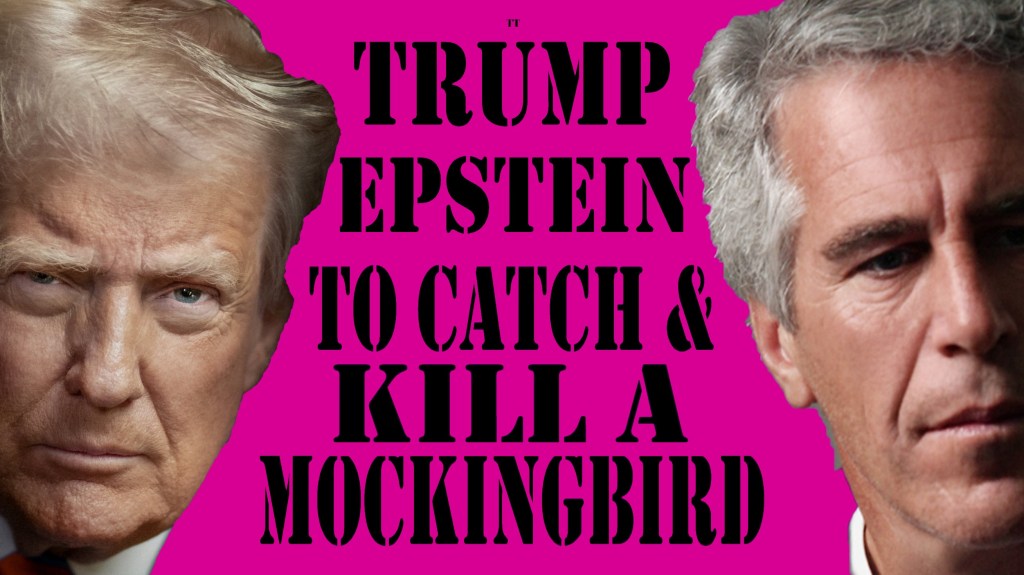
In 2002, New York magazine ran an infamous article on Jeffrey Epstein, which significantly raised his public profile. In the article, Trump called Epstein a “Terrific Guy”, but within a few years, everything had changed. Soon, both Trump and Epstein were trying to take control of the press in different ways.

Jeffrey Epstein’s 2002 trip around Asia and Africa with Bill Clinton raised his public profile significantly. If Epstein wanted his activities to remain shrouded in mystery, Landon Thomas Jr.’s now infamous article for the New York magazine entitled: “Jeffrey Epstein: International Moneyman of Mystery” acted as a proverbial wrecking ball.
Epstein’s media strategy post-2002 changed. He began a concerted effort to control future mentions of his enterprises. New York magazine, in particular, had become one of the publications that focussed its gaze upon Epstein’s operation, and this led to increased questions and speculation concerning Jeffrey Epstein’s enterprise.
Between 2002 and 2007, the relationship between Jeffrey Epstein and Donald Trump went from “terrific” to “banned from Mar-a-Lago”. During this investigation, two things became clear: Epstein chose to align himself with a New York elite which went on to oppose the MAGA movement, and Epstein and Trump were willing to pay money to “catch and kill” negative press.
Essentially, after 2002, Epstein began setting up his new chessboard, unaware that he was already approaching checkmate.
A Game of Chess
After Epstein’s media profile had increased due to his very public trips with former-President Clinton, he is reported as telling a friend:
“If my ultimate goal was to stay private, traveling with Clinton was a bad move on the chessboard. I recognize that now. But you know what? Even Kasparov makes them. You move on.”
The latter quote was from the New York magazine and after they began focusing on his operation, Epstein decided to act. Epstein desired to be in total control of his image, and the New York mag’s Landon Thomas Jr. piece was one of a series of troublesome articles focusing on Epstein which had been released since the millennium.
The following year, Crain’s New York Business magazine released an article entitled “At Deadline”, which revealed Jeffrey Epstein’s involvement in a consortium of New York’s richest narrative manipulators as they looked to purchase the New York magazine. The article states:
“Primedia set Dec. 11 as the deadline to bid for its New York magazine. Advertising Age reports in today’s edition that among the reported suitors is a consortium involving New York columnist Michael Wolff, Deutsch Chief Executive Donny Deutsch, Cablevision CEO James Dolan, Miramax Chairman Harvey Weinstein and financier Nelson Peltz. Jeffrey Epstein, an investment manager, was considering joining the group, say executives involved in talks. Other bidders are The Learning Annex, Tribune Co., CurtCo Media and American Media.”
This fascinating group of wealthy New York elites had various connections to Epstein. It should be noted that Michael Wolff, who was involved in the bid for the New York Magazine alongside the likes of Harvey Weinstein and Jeffrey Epstein, was also a member of Edge while it was 100% funded by Epstein. Wolff has since begun to rewrite the narrative concerning not only Epstein but on Donald Trump, too. In 2018, Wolff published “Fire and Fury: Inside the Trump White House”, which painted Trump’s administration as chaotic, followed in 2021 by “Landslide: The Final Days of the Trump Presidency” which also weaved an unflattering image of Trump’s first term.
A Daily News article from 3 December 2003 mentioned Epstein in relation to the final bidding process for New York magazine. They also mention another name linked with the deal, Mort Zuckerman, the former partner of CIA-feminist Gloria Steinem. In fact, Mort Zuckerman had started a relationship with Steinem just after she had split with Epstein’s victims’ lawyer, Stanley Pottinger, who was, at the time, sharing an office with Epstein and running guns with him during Iran-Contra for the CIA.
The Daily News article entitled: Call for final bids, stated:
“Allen & Co. is fielding offers for Primedia. Interested players include American Media, Daily News chairman and co-publisher Mortimer B. Zuckerman, ad exec Donny Deutsch, The Learning Annex, Tribune Co. and Curtco Media. Also mentioned in financial circles is a possible dark horse—investment manager Jeffrey Epstein, a Democratic Party contributor called “International Moneyman of Mystery” in a New York profile last year. He couldn’t be reached.”
Donny Deutsch’s involvement is notable because he co-managed Clinton’s 1992 election campaign. Born Donald Jay Deutsch, he attended the Wharton School, the same business school as Donald Trump and Elon Musk. Deutsch also knew Donald J. Trump very well, appearing on The Apprentice on a number of occasions. In July 2017, the German newspaper Süddeutsche Zeitung printed an article entitled: Trump vs. “Morning Joe”: An absurd feud becomes explosive, reporter Beate Wild wrote:
“On Friday, the topic was discussed with entrepreneur and talk show host Donny Deutsch on Morning Joe. He called the president a “vulgar pig” who was “physically repulsive” and said Trump was “mentally unsound.”
Another notable name involved in the consortium that sought to purchase the New York magazine was financier Nelson Peltz. As Donny Deutsch was involved in Clinton’s 1992 election campaign, Nelson Peltz is a Republican donor who threw a fundraiser for Donald Trump’s re-election campaign in 2020 but publicly rejected Trump’s presidency after the so-called “storming of the United States Capitol”. Peltz previously gave the maximum allowed donation of $250,000 to the second inauguration of President George W. Bush.
The other entities listed as bidders included The Learning Annex, which ran real estate expos a few years later that featured Donald Trump, who received $1.5 million for each of his 17 presentations over 2006/2007 for the organisation.
The involvement of American Media (AMI), which later rebranded to a360media, is extremely notable. They were also central to what are described as “catch-and-kill” scandals involving Donald Trump. The company paid $30,000 to one of the Trump Tower doormen for his story about an illegitimate Trump child. In catch-and-kill operations, a media company buys the rights to tell a story only to shelve it and, essentially, keep it hidden. AMI’s content officer, a man named Dylan Howard, denied such allegations and claimed that the doorman’s story lacked credibility. AMI did the same with the story of the Playboy model Karen McDougal, who was paid $150,000 for exclusive rights to her allegations of her affair with Donald Trump. They again failed to publish the story, and the aforementioned Dylan Howard, along with the AMI CEO David Pecker, were granted witness immunity for testimony in the trial of Donald Trump’s lawyer, Michael Cohen.
When the bidding began for New York magazine; all of the aforementioned bidders were unsuccessful. With the Daily News reporting on 17 December 2003 in an article entitled, $55M buys New York Mag, where it states:
“In a surprise move that would make for a juicy cover story in New York magazine, hard-charging investment banker “Bid-’em-Up” Bruce Wasserstein emerged late from the sidelines and will buy the weekly for $55 million.”
In the end, Bruce Wasserstein took control of New York magazine, however, the intentions of Epstein and his associates were made clear. They desired to control the narrative.
Another Publication on Epstein’s Radar
It was only a couple of months before the same consortium was trying to purchase another media organisation. Radar magazine had only released two issues of their magazine in 2003, with a tag-line which read: “Pop, Politics, Scandal, Style.” By 6 February 2004, Daily News were again reporting on the consortium’s activities, stating:
“A group of high-profile New Yorkers that failed in its recent attempt to buy New York magazine is said to be pursuing other projects, including a possible bankrolling of editor and publisher Maer Roshan’s Radar. The group includes Daily News chairman and co-publisher Mortimer B. Zuckerman, Miramax Films co-chairman Harvey Weinstein, Triarc Cos. CEO Nelson Peltz, advertising exec Donny Deutsch and financier Jeffrey Epstein.”
Radar’s founder, Maer Roshan, also had significant roles in political events concerning one of Epstein’s closest allies and New York magazine. In 1994, the then editor of New York magazine, Kurt Andersen, hired Roshan as Deputy Editor. Roshan produced the first post-impeachment interview with Monica Lewinsky for New York magazine and went on to work for The New York Times, FourTwoNine, the Miami Herald and Harper’s Bazaar to name a few.
It took almost a year from the consortium’s interest being registered for the plans to revive Radar to come to fruition. On 11 April 2005, The New York Times’ Katherine Q. Seelye wrote:
“It fell to earth last time after just two issues. That was in 2003, when it ran out of cash. Last October, Mortimer B. Zuckerman, the publishing and real estate mogul, and Jeffrey Epstein, the financier, stepped in with millions of dollars (reportedly as much as $25 million) to revive Radar after Mr. Zuckerman fell short in a bid to buy New York magazine.”
Instead of restoring Radar to print, they planned to start the magazine as a website. Later reports claim that the figure Roshan secured from Epstein was actually closer to $10 million.
One of those who supplied additional backing to the consortium’s bid was Ron Burkle of Integrity Media. Burkle could also be found on the flight logs of the Lolita Express. In the NEWSPASTE article, Epstein 101: Influence and Collusion, I wrote about Ronald Wayne Burkle’s flights with Clinton and Epstein during their African odyssey. The New York Times described Burkle in 2006 as:
“Mr. Burkle, a kingmaker in California political circles and a confidant of a former governor, Gray Davis, has also been a loyal supporter of Mr. Clinton and former Vice President Al Gore, who both now have business relationships with him.”
In the aforementioned Epstein 101 article, I also reveal how Burkle was focused on buying some other big brands within print media. In 2007, Burkle was unsuccessful in his attempt to purchase the Los Angeles Times and the Chicago Tribune, with the NEWSPASTE article stating:
“Ron Burkle was “shut out” of a bid to buy a couple of American newspaper companies. Burkle along with another billionaire, Eli Broad, had made an unsuccessful attempt to buy the Tribune, which owned both the Los Angeles Times and the Chicago Tribune, as well as later considering “topping” Rupert Murdoch’s bid for Wall Street Journal publisher Dow Jones, as reported by Forbes in September of that year. Instead Burkle invested in a Chinese media company which had become an “out-of-favor” asset.”
It wasn’t only media outlets that Epstein had targeted during this period. In August 2004, Epstein was outbid in a race to buy the New York branch of Elite Model Management. For years, Epstein surrounded himself with women who worked for Elite Models, including the former-Elite Model Nicole Junkermann, who has since become the associate of Peter Thiel, Elon Musk and Ehud Barak. The Evening Standard reported in an article entitled: New York branch of Elite is sold for £4.4m, Sarah Marks writes:
“Elite entered Chapter 11 bankruptcy protection proceedings in the US after two lawsuits. According to the New York Post, Miami-based Eddie Trump—no relation to billionaire Donald—outbid financier Jeffrey Epstein and ID Models boss Paolo Zampolli. The sale does not affect the parent company in Switzerland or affiliated branches worldwide.”
To Catch and Kill a Mockingbird
Although I’ve only focused on events from 2002 to 2007, Epstein continued to influence media organisations until his death. However, after 2007, there was no point for Epstein to catch-and-kill troublesome stories; Epstein’s reputation as a sex offender would follow him wherever he went. Epstein wasn’t only influencing the press via takeover bids and other investments; he was also using his funding of Edge to get reporters on his side.
Some of those who are now central to creating the narrative concerning both Epstein and Trump were previously involved with Epstein. The aforementioned Michael Wolff is a perfect example of this. He not only entered a business consortium with Epstein during the peak of his criminal enterprise, but he was also involved with the Epstein-funded Edge. Then Wolff became central to the anti-MAGA movement, which rose up to oppose Trump’s time in the White House.
Jeffrey Epstein also had significant links with major MSM journalists via his other organisations. To hammer the point home, this is a list of some of the other famous newsmen and women who linked arms with Jeffrey Epstein at Edge. They include:
Jerry Adler who was Senior Editor at Newsweek; Natalie Angier of the New York Times; Editor of Wired Magazine in Italy, Carlo Antonelli; Vanity Fair’s Special Correspondent Nick Bilton; David Brooks of The New York Times; Andrew Brown of The Guardian; Benedict Carey of the New York Times; Laura Chang of The New York Times; Executive Producer of TED Media, June Cohen; Der Spiegel’s Georg Diez; CBS News’s Dan Dubno; Fortune Editor Philip Elmer DeWitt; The New York Times Company’s Marc Frons; Reason’s Contributing Editor, Mike Godwin; The New York Times’ Katie Hafner; Quentin Hardy of The New York Times; Columnist for The New York Times, Virginia Heffernan; The New Yorker’s Jim Holt; Mike Holtzclaw of the Daily Press; Arianna Huffington of The Huffington Post; The Guardian’s Alok Jha; Editor in Chief of Feed, Steven Johnson; YouTube’s Salar Kamangar; Cultural Correspondent for Neue Zurcher Zeitung, Andrea Köhler; the New Statesman’s Marek Kohn; Wired Contributing Editor Jonah Lehrer; Steven Levy, Senior Editor for Newsweek; Steve Lohr of The New York Times; the Pulitzer Prize-winning Reporter of The New York Times, John Markhoff; CEO of Yahoo, Marissa Mayer; Managing Editor of Release 1.0, Jerry Michalski; the Founder and Editor of Fiction Magazine, Mark Jay Mirsky; Nature’s Features Editor, Oliver Morton; Steve Nadis, the Contributing Editor to Astronomy Magazine; The New York Times Dennis Overbye; Sudwestrundfunk’s Gábor Paál; Steve Petranek, the Editor-in-chief of Discover Magazine; The Wall Street Journals’ Editor Thomas Petzinger; Daniel Pink, the Contributing Editor of Wired; Senior Editor of Discover Magazine, Corey S. Powell; Spencer Reiss, the Contributing Editor of Wired Magazine, The New York Times’ Ed Regis; Editor-In-Chief of Scientific American, John Rennie; Louis Rossetto, Editor and Publisher of Wired and HotWired; David Rowan, Editor of Wired UK; Larry Sanger, Co-founder of Wikipedia; Editor-in-chief, Feuilleton of Neue Zürcher Zeitung, René Scheu; Ludwig Siegele of the The Economist; Michael Specter of The New Yorker; Barbara Strauch of The New York Times; and, finally, The Wall Street Journal’s Jason Zweig.
In the same way that these journalists formed significant ties with Jeffrey Epstein—some of them even after he was outed and convicted as a sex offender—many of them later positioned themselves as opposing both Donald Trump and his MAGA movement.
Both Donald Trump and Jeffrey Epstein aimed to manage their public persona. Trump did this by paying hush money and having his allies in the media catch-and-kill stories, which concerned him. Jeffrey Epstein also aimed to catch-and-kill negative press, but he went even further, trying to wrestle control of entire media organisations. It should also be noted that neither man was able to fully catch-and-kill the stories which plagued them.
Once Donald Trump took office, many of Epstein’s previous colleagues and business partners relentlessly attacked and undermined his presidency. Whether this was related to a previous ideological split in the Democratic Party or whether it was savvy political thinkers creating a faux dialectic, Epstein’s relationship with Trump never publicly returned to the golden age of 2002.
There is a possibility that a manufactured dialectic was designed to allow what we’ve seen unfold. During the period we’ve examined, the Democratic Party were not in the White House. The party elite were looking for potential future leaders who could regain power. At the time, Barack Obama was relatively unknown, and the very essence of “hope and change” was lacking within the party rank and file.
When all seemed lost, something miraculous happened. Instead of the Democrats of 2002 taking control of the White House, many of them eventually took control of the Republican Party. A disgruntled Donald Trump, who had been consistently overlooked as a potential Democratic Party nominee for President, repositioned himself politically speaking. Other solid Democrats of the era have also since switched allegiances in what appears to be a naturally occurring manner.
However, imagine if Clinton, Trump and Epstein had decided they didn’t want to compete fairly to gain the presidency on behalf of the Democrats. Instead, what if they decided to rig the game? So that whoever the electorate voted for, Republican or Democrat, they’d always be picking from the same very small group of wealthy elites.
As the voting public, we are often turned against each other. We argue over key issues and, however much we disagree, we always get the same result. We are told that those who are jostling for power during our elections are opposing forces, while at the same time we watch them all mingle together, cavort, and party, as though they’re brethren. We’ll study that in the next article involving Trump and Epstein.






 NEWSPASTE