


by Johnny Vedmore and Jules Ballantyne
How the infamous sex offending BBC DJ became involved in spy games, was almost killed in Moscow, and pioneered Hip-Hop.

In post-war Britain, the Cold War was raging and the weaponry of choice was cultural rather than physical. The Soviet-era spy games of the 1960s were all-pervasive. Regardless of whether you were a politician, musician, actor, gangland villain or even the owner of a high-class buttery, everyone with influence was being deployed to fight the Soviet menace. The nightclubs of the United Kingdom were awash with dead letter drops and high-end influence operations, and those who ran the major night spots around the UK became some of the most influential power brokers of the era. These were the Kate Meyrick’s of their era; both wealth and danger were always around the corner.
The Black Hand series does not explore the world of simple nightclub owners. Instead, we are examining the high-level trendsetters of the era. The people we’ve looked at so far were major pioneers in the nightclub world, a world which was often sordid and obscure. Female patrons such as Esmeralda Gullan and Barbara Knox Marsh were dynamos, revolutionising the club industry throughout the mid-50s. Proprietors like Horace “Hod” Dibben and his two wards, Patsy Morgan Dibben and Mariella Novotny, were the inventors of the man in a mask Satanic sex parties which have become an iconic symbol of a ludicrously indulgent elite.
In the high-class nightclubs of London during this period, the Venn diagram of pioneer club owner and Soviet-era spy almost formed concentric circles. One can go as far as to say that no one could hold the position of nightclub host in Kensington, Belgravia or Mayfair unless they played the Establishment’s game. The most influential figures of this generation gained significant access to politicians, royalty, and celebrities. We have also investigated the gangland bigwigs who capitalised on the original takeover of the nightclub scene, which included the Kray twins, the Brinks Mat robber Billy Hill, and gangland villain Ronnie Dice. During the 1950s and 60s, intelligence-linked gangsters weren’t the only nefarious characters to use nightclubs, sex compromise, Satanism and their significant connections to gain power and control. There was one infamous nightclub manager, DJ and celebrity influencer in particular who was involved in these ever-developing spy games.
Jimmy Savile was one of the most prolific sex offenders in British history. While he was offending, he was protected by the British royal family, the ruling elites on all sides of the political spectrum, as well as the security services. He was not being protected by the tentacles of the United Kingdom’s intelligence infrastructure for no reason. Among his many accolades, Jimmy Savile was a spy.
For those who grew up with Jimmy Savile on the BBC, the idea that he was a master in the art of spy-craft may seem ridiculous. However, the state uses trending influencers to do their dirty work. As you might already know, Savile was a peculiar chap with various links to the dark arts. Superficially, Savile’s whole existence lent itself to Satanism, Wicken and Black Magic. He was born on Halloween, he was a seventh child, he regularly wore ceremonial gowns and, on top of that, he was rumoured by various former work colleagues to dabble in witchcraft.
However, witchcraft and spycraft were not Savile’s only pastimes; he was also a musical pioneer. Jimmy Savile didn’t only have a direct consequence on the way music was presented at the nightclubs we’ve investigated in this series, he also fundamentally revolutionised musical form and style. There was one musical genre in particular that Jimmy Savile revolutionised: Hip-Hop. It wasn’t only P Diddy’s wild Satanic-themed sex parties which originated from this era; so did the musical genre which brought Sean Combs such wealth.
Welcome to the eighth part of the Black Hand series. This is the story of Comrade Savile, the inventor of Hip-Hop.
The Young Jim Savile
James Wilson Vincent Savile was born in Consort Terrace, Leeds on 31st October 1926. He was the seventh child of Vincent Joseph Marie Savile and Agnes Monica Kelly. Vincent and Agnes married in 1911 at St. Cuthbert’s Chapel in County Durham. The Savile name had derived from French-Norman roots. In Eure-et-Loire during the time of William the Conquerer, the Sainville family were loyal enough to the King that they were gifted lands in England after the Norman invasion. The Savile surname appeared in England around the 12th century, and the high-ranking members of the family loyal to the crown were given lands in Yorkshire. A religious grant from the reign of Henry III also mentions the Saviles.
Jimmy Savile had inherited his two middle names from his ancestors. While Vincent was his father’s name, Wilson came from Savile’s paternal grandmother Jane Walker Wilson, whose father, Alexander Wilson was an American-born District Superintendent of a railway clearing house
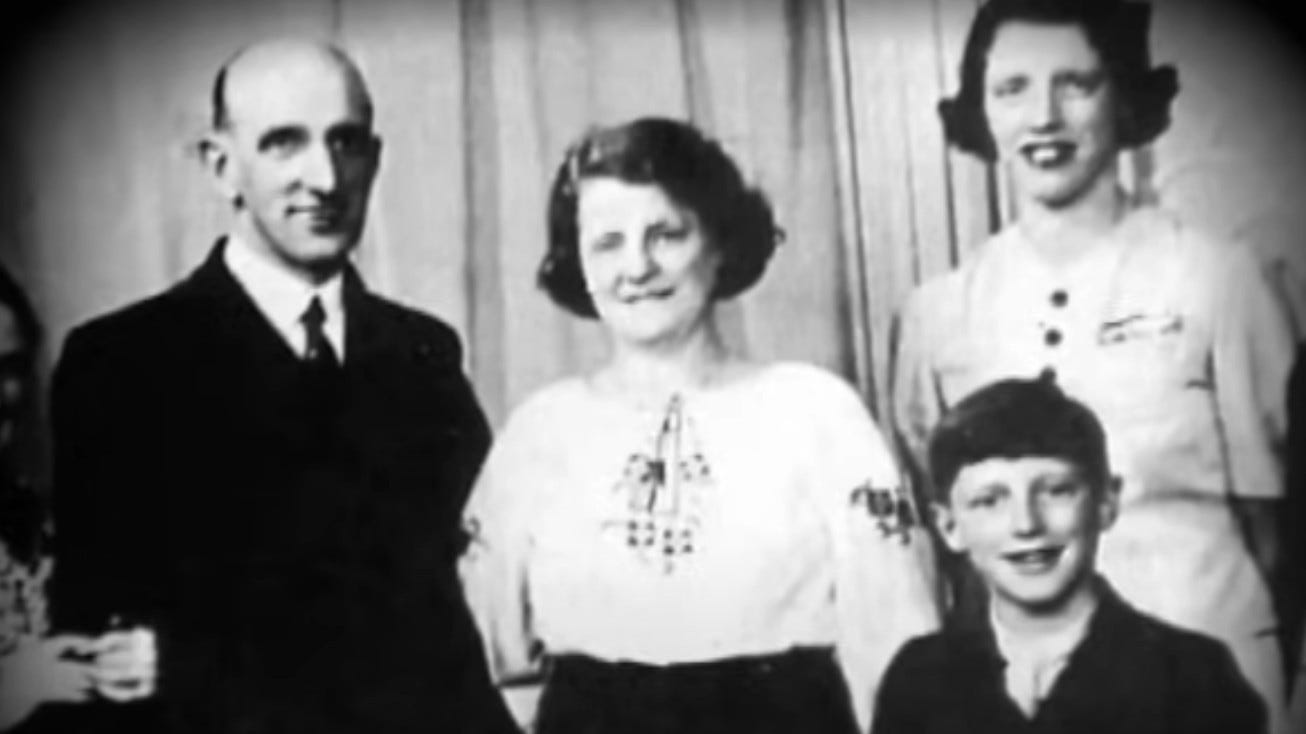
.Savile left school while just a teenager. By the age of 14, he was working at the Waterloo Colliery in Leeds. As one of the so-called Bevan Boys, Savile spent seven years down the mines, telling Michael Parkinson and guests:
“Now there’s nobody but nobody ever did 8 hours down a pit and came back as immaculate as they set off. With white shirt and everything like that. They were quite convinced that I was a witch… If you go to South Kirby now, you’ll get some of the old miners, when you say: “Jimmy Savile’s done well, hasn’t he?” And they’ll look around and they’ll say: “He’s not what you think, you know? The forces of darkness are at work there.”
Once Savile’s time as a miner had come to its conclusion, he worked as a farmhand, a scrap-metal dealer and eventually became a porter at Broadmoor Hospital. The latter job gave Savile access to vulnerable people and his time at Broadmoor may have been the genesis of his well-reported malevolent, criminal behaviours.
In this edition of The Black Hand, we will reveal new information about Savile’s involvement in propaganda campaigns led by Western intelligence agencies. To do so, we need to go back further and deeper than anyone has dared go before. Let’s start at 22 Consort Terrace in 1942, where a young man is advertising a ”Gent’s Cycle” for sale in the Yorkshire Evening Post for £6. It was wartime, and, like everyone in Britain during the peak of World War II, the Savile family needed funds. A year later we find 22 Consort Road listed again in the Yorkshire Evening Post as they advertised a “large front basement combine room” preferably to a “middle-aged lady”.
At this time, Jimmy Savile was going by the names “James Savile” and “Jim Savile” with his last name often misspelt. In 1942, Savile was 16 years old, and cycling was the first long-distance sport he began to focus on. Only 5 years later, a Yorkshire Evening Post article entitled “Pilgrim Cyclists’ Ride to Lourdes” centres around the exploits of a 21-year-old “Jim Savile”. The report tells of the Leeds and District Section of St. Christopher’s Catholic Cycling Club being “not too sure of the attractiveness of a mass cycling pilgrimage to Lourdes”. The club’s national headquarters in London had planned the trip for the following September with a meeting to arrange the event in Stratford-Upon-Avon the week after the article went to print. The article explains why the club were uneasy with the plans, stating:
“Main reason for their hesitation is the experience of Jim Saville [sic], their 24-year-old ex-naval Chapeltown member, who has done five cycling trips in France since VE-Day—he believes he was first [sic] post-war British cyclist to get into the Continent—and sets out for his sixth trip on Good Friday.”
France was barely out of the grip of Nazi occupation and was awash with military checkpoints, ongoing operations, and intelligence recruitment programs. During this period, travel was restricted in large parts of Europe, poverty was rife, and devastation was all around. Post-war European checkpoints weren’t simply to control the flow of traffic, they were used to identify potential war criminals, arms smugglers, people traffickers, and foreign intelligence operatives. If a potential spy was picked up, they were more likely to be recruited rather than arrested. This was the Cold War, and the British and Americans were ahead of the game.
The latter article claims that Savile was “ex-naval”, which could be one of the many white lies he made throughout his career. However, it may be true, and Savile may have already been a Navy recruit by this time. The article continues with an interview with Mr. John Keavey, who stated:
“Jim Saville [sic] tells us accommodation and food is very difficult,” said Mr. Keavey. “On one of his trips he was stranded in Paris and had to seek hospitality from the American Army. We think the £15 should be nearer double. There is also the point that many of our members have returned from the Forces and feel they’ve had enough of roughing it for one season at least. Still, we shall give the conference Saville’s information and decide when we know more.”
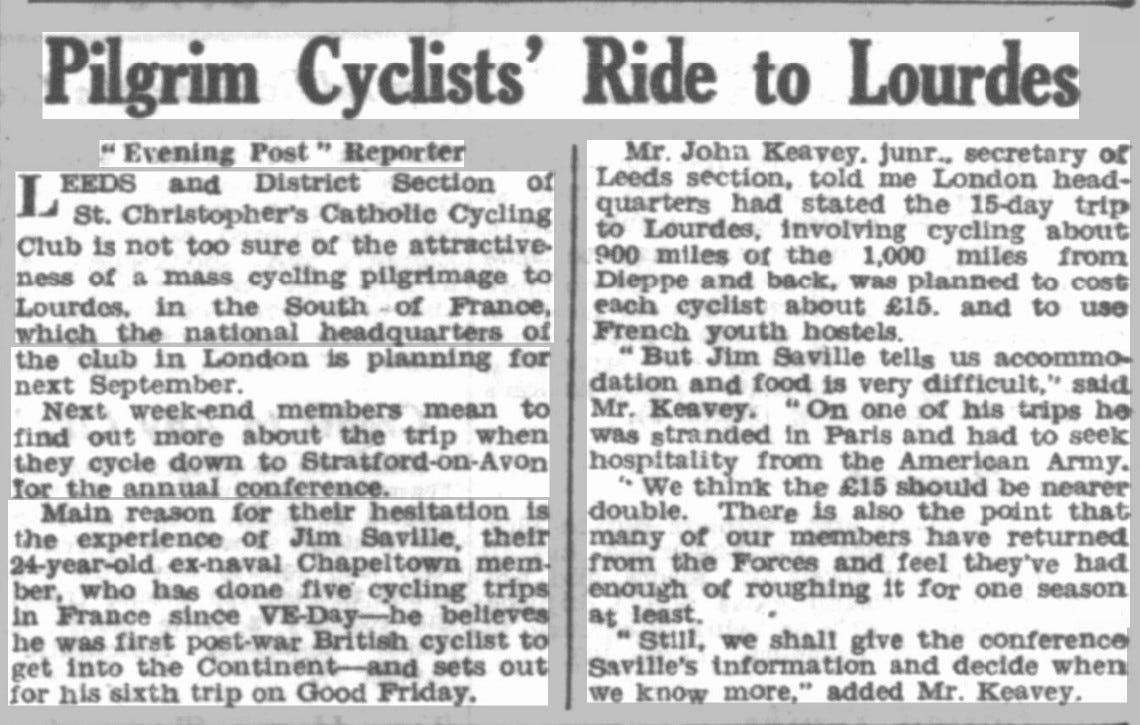
The article claimed Savile had already cycled to France five times since the European theatre of World War II came to a close, with a sixth journey planned just weeks after the article was published We can assume that Savile’s offending started somewhere and post-war France would have presented a potential sex offender with a litany of opportunities. It should also be noted that Jimmy Savile was a perfect recruit for various Western intelligence agencies, especially during the dawn of the Cold War and the emerging East vs West cultural warfare of the era. After all, Savile was a man of many faces; he was extremely talented, and he had been entertaining people for many years. In fact, the same year that his reported cycling expedition to Lourdes was announced, he was also pioneering Hip-Hop.
J Diddy – Hip-Hop Pioneer
By the 1950s, Jimmy Savile entered the nightclub industry, and directing dance halls led to a career in the music industry. When he started running dancehall nights in venues such as The Palace, he often went by the name “James Savile”, and his nights were like nothing anyone had ever seen before. Savile used the technology of the time in innovative ways, and his use of media left him decades ahead of the competition in many ways.
Jimmy Savile’s time within the northern dance halls saw him gain a reputation not only as a musical pioneer but also as a tough man. He was already someone who would use young girls as collateral. Savile himself made a selection of statements to Will Yapp while he was filming “When Louis Met… Jimmy” about this period of his life, stating:
“In the dancehalls I invented zero tolerance, I wouldn’t stand for any nonsense whatever—ever. Ever ever ever. I was always in trouble with the law for being heavy-handed. Always. But I couldn’t care less about that… I never threw anybody out. Tied ’em up, and put them down in the bloody boiler house until I was ready for them, at 2 o’clock in the fucking morning. They’d plead to get out! Nobody ever got slung out of my place… We’d tie ’em up and everybody would come back and I was the judge, jury and executioner… You know, if a copper came and said “You was a bit heavy with them, that kid or those two guys, whatever”, I’d say “Your daughter comes in here, she’s 16, she’s not supposed to come into town but she does and she comes here. Presumably you’d like me to look after her, if you don’t want me to look after her, tell me, and I’ll let them dirty slags do what they want to her”.”
By 1962, commentators were ignorant of Jimmy Savile’s real nature. He was one of a kind. In a Liverpool Echo article entitled: “The So Odd Man Out,” the reporter first posits that there are “two main ways of presenting gramophone records over the air.” They claim that DJs either “go all out for laughs” or aim to “project a self-assured yet warm and friendly personality,” with the author going on to write:
“Jimmy Savile does not fit into either of these categories. He gabbles, mumbles, slurs and races through his compering duties. He repeats himself. More often than not his stuff is unscripted. He employs a brand of zany humour but he isn’t really a comedian.”
The article goes on to say:
“And yet Jimmy Savile has become one of the nation’s favourite record-playing personalities. We can half solve the Savile mystery by comparing his astounding popularity to that of Ena Sharples and company. Savile gives all his work a Coronation Street stamp. He’s one of us. Or, if you prefer, one of them.”
In a 2004 Guardian article written by Harland Miller, the writer and artist lays out the case for Jimmy Savile inventing Hip-Hop style many years before Afrika Bambaata. In the article entitled “Lord of the Bling”, Miller stated:
“I relaxed against the wall with my book: Jimmy Savile’s autobiography Love Is an Uphill Thing. I’d just reached the chapter in which Jimmy came to invent the “twin-decks” by paying a local metal worker to weld two domestic record decks together for more continuous play at his dance parties in Leeds. In so doing, he potentially became the first DJ.”
Miller points out that Savile’s flamboyant tracksuits, flashy gold chains, and wrap-around shades were part of Savile’s public image by 1973, a decade before the B-boy style of New York became popular.
Although Savile being the grandfather of Hip Hop may be a stretch, the welding of the two domestic record players cannot be understated in the development of DJing. Savile had invented a way to seamlessly mix tracks for continuous play. The term “disc jockey” was coined in 1935 by radio commentator Walter Winchell, and the world’s first-ever DJ dance party was in 1943. A 17-year-old Jimmy Savile played records in a function room of the Loyal Order of Ancient Shepherds in Otley, England. Savile claims to have been the first to use twin turntables for continuous play in 1947, and by 1958 this earned Savile a job at Radio Luxembourg.
Radio Luxembourg was a vital weapon in the Establishment’s propaganda arsenal. The station was created during the 1930s in response to all-pervasive European state media such as the BBC. During World War II, the radio station was commandeered and controlled by the German propaganda machine. After the war, the British and Americans ensured they turned the platform into a Western stronghold.
Savile talked about being recruited by Radio Luxembourg on a few occasions, including a BBC Radio 1 Christmas show. Savile recants the tale of being approached in his dancehall, stating:
“A million years ago, I was playing records in my dancehall when a fellow came up, and he said: “I’ve never seen records played liked this before. Do you fancy a job on Radio Luxembourg?” And I said: “Why Not?” I’d never been in a radio studio in my life. And he said: “Okay, come to London for an audition,” and I said: “No!”. He said: “Why not?” and I said: “You’ve seen all there is, you either want it or you don’t want it,” and he said: “You’re a bit of a character you are, aren’t ya?” And I got a telegram, do you remember telegrams? I got a telegram a week later and it said: “Your Radio Luxembourg show starts on Thursday.” So I shot down to town, and I was working for the Warner Bros. Film Company, and they decided to bring out records; the biggest name in film, the biggest name in sound.”
On Radio Luxembourg, Savile became the presenter of the Warner Bros. Record Show with an episode on Wednesday listed as “The Teen and Twenty Disc Club” and another show on Saturdays called “Guys, Gals and Groups.” Savile’s rise was meteoric. Before long, James Savile was the highest-paid DJ in the trade on a wage of approximately £20,000 per year.
Comrade Savile
Although we are led to believe that the Soviet Union was an unwelcoming and inhospitable place for Westerners during the late 1950s and 1960s, in reality, cultural exchange programs were a regular occurrence between the East and West. For the West to influence the East, they had to keep their proverbial foot in the Russian door, and visa versa. This was happening at all levels during this period. High-level American diplomats such as John Kenneth Galbraith were visiting the Soviet Union under the pretence of examining the rural Soviet economy. At the same time, one of those mentored by Galbraith, the supposed feminist Gloria Steinem, was also running operations for the CIA targetting Soviet-run festivals on the European mainland. The Soviet Union’s influence during the Cold War was being challenged, not by war, but rather by the dissemination of cultural influence.
The British were as busy as the Americans during this period, and the post-war era was a golden age for American and European diplomacy. Both the US and the British were recruiting assets to use within the burgeoning propaganda war, and the gramophone became central to this process. Once their elite army of information warriors was on board, they were often sent to the frontlines.
Jimmy Savile took more than one trip to the Soviet Union during the 1950s and 1960s. We can find evidence of this within the newspaper archives. On Thursday, 1st November 1962, the South London Observer ran a column entitled “Swinging Jimmy” in the Show News section of the newspaper, writing:
“Autographs were the order of the day, but Jimmy still managed to keep the “cats” and “kittens” as he described the youngsters, dancing. “This is really great,” he told me. “I like to see the kids enjoying themselves. I play whatever they want to hear and find that keeps them going.” Recently returned from Hollywood (where he met Elvis Presley), Moscow and a tour of France. Jimmy hopes to go to Jerusalem at Christmas “to dig the scene.” he explained.”
Savile often projected out the power he had over the younger generation, and he had a penchant for insinuating his sinister sexual behaviour during interviews and articles. Savile mentioned his Moscow trip a few years later. In the People newspaper on Sunday 4 July 1965, he writes:
“If anybody in Skegness has a spare room and one or more teenage daughters to talk to over supper and would like a long-blond-haired lodger, with a long, blond Rolls-Royce, for the night, let me know. I’ll give what I was going to spend in the hotels to the local hospital fund. I never had this much trouble even when I applied for my visa to go to Moscow.”
In one of the last interviews Jimmy Savile ever gave before his death, he spoke from his hospital bed in more detail about a visit to Moscow while he was working for Radio Luxembourg, stating:
“Now, I managed to get a visa, which is another story entirely, to go to Soviet Russia. That was when Premier Khrushchev was in power. And in those days all there were which you could listen to on were transistor radios. They were called transistor radios, little things. And I took my transistor with me to Russia, and I was staying in a big hotel called the Hotel Ukraine. And I went out at 10 on Wednesday night to stand on the steps, bitterly cold as it is in Russia at 10 at night. And I dialled Radio Luxembourg, and lo and behold, I heard my own program coming out, a bit faint, but there it was. Now, if you put a pin in Luxembourg and a piece of string reaching out to Moscow, and then draw a circle with it, that was the potential listening figure, and that covered this part of the world.”
Jimmy Savile’s visa issues when trying to visit the Soviet Union weren’t well-reported at the time, but later Savile went into more detail. Within his Sunday column in the People newspaper on Sunday 17 August 1969, Savile stated:
“The longest oddest time was when I went to Russia for two weeks. This was at the height of the cold war, a few years back, and it was very difficult to get a visa. After a lot of top level fiddling I finished up on a plane to Moscow. Having just finished at the Top of the Pops’ studio with only an hour to catch the flight, therefore no time to change. I boarded the aircraft looking like a colour cartoon. Gold jacket, bow tie, biscuit shirt, fawn trousers, and a pair of green patent leather shoes!”
Even though the Moscow trip was important enough that Savile required “top-level fiddling” for it to take place, there is no real reason given why he needed to go to Moscow during the height of the Cold War. The journey was not a smooth one, and the story escalates into the unexpected soon after he landed. Savile wrote:
“At Copenhagen an official told me that my bag had been put on the wrong plane. Oh. Boy! I arrived in Moscow and the airport came to a halt. I fitted into the Soviet scene like a peacock on a bomb site. The lost bag with all my ordinary clothes and shaving gear turned up 10 days later. Those 10 days were among the greatest unbelievable situations ever.”
What Savile says about his time in Moscow sounds more like the Bourne Identity than standard BBC business. In the same People article, Savile goes on to say:
“A mix-up with the secret police, running into, and over, a pedestrian when I was being driven round a display park in an electric three-wheeled car, almost getting shot in a side street and just saved by my own security guard. The worst two weeks of my life, but I loved the people there. Pity they all speak Russian.”
Savile considered the Moscow trip to be the worst two weeks of his life. He admits to a run-in with Soviet secret police, running over a pedestrian, almost getting shot in a side street, and having to be saved by his security guard. These events were serious enough that one would assume Savile would have mentioned them elsewhere. However, he waited years to mention them publicly.
Trying to work out when Savile took this trip to Moscow isn’t easy. In the previously mentioned 1962 article entitled “Swinging Jimmy”, a trip he took to Moscow is briefly noted. However, in the 1969 article, Savile mentions that he had just finished recording Top of the Pops’ and went straight to the plane. Top of the Pops premiered in 1964, meaning Savile visited Moscow more than once.
In 1968, Savile addressed a congregation at St. Augustine Roman Catholic Church in Tunbridge Wells. Dressed in a green and gold tracksuit which had been presented to him by the National Amateur Body-Building Association, which he was the president, Savile had just come from judging the Miss Universe Contest in London. The following day, Savile donned his green floral witches gown and sandals. The article in the Kent & Sussex Courier on Friday 27 September 1968 entitled: “Jimmy Savile Talks About God, And Winning Lines,” stated:
“Music for the service was provided by a four guitar ensemble, and Fr. William Howell, who officiated, welcomed the diminutive disc jockey who told the congregation, among them girls of the convent in their scarlet robes, about his recent lone visit to Moscow and the suspicion it evoked.”
The previous year, Savile had been part of a trite propaganda campaign targetting Russia. In an article in The People newspaper on 12 November 1967, entitled: “This is Comrade Savile . . .”, the reporter states:
“DISC-JOCKEY Jimmy Savile, who revolutionised pop music presentation on B.B.C. TV, has been signed up to lead another revolution—in Russian. He will present the first “Top 20′ radio programme to be beamed by the B.B.C. Overseas Service to Russia—with his own comments dubbed on the sound track in Russian. Jimmy said yesterday: “This should be a smash. I’m going to record the first programme in the pit where I used to work as a miner “
Savile wasn’t only sent on multiple missions to Moscow, some of which were not reported, but his shows were also being dubbed into Russian. It was clear that the Western propaganda chiefs believed that Savile’s enigmatic style was a powerful weapon against Soviet stoicism. Even though Jimmy Savile only mentions one trip to Moscow, we can trace around three visits during the 1960s. Regardless, the Cold War didn’t end when the seventies began.
The Religious Man
During the Cold War, Jimmy Savile was a hot commodity. After all, the frontlines of the growing information war were the printed media, television and radio, and Savile had his fingers in every pie. Not only was he a well-connected friend of the ruling elites, but Savile had also won the hearts of the British public.
In the early 1970s, his focus surprisingly switched to religion. In one of his weekly People columns from December 1971, Savile wrote:
“The appointment of the head of B.B.C, religious dept. means that there will be an automatic re-think about the quite considerable amount of such shows on radio and TV. My own “Speakeasy” radio show, run by the religious dept., has zoomed to the No. 1 listening spot and our producer, the Rev. Roy Trevivian, has been moved to cast his eyes overseas so we are all trekking off to Moscow, to do a programme on what makes the young tick over there.”
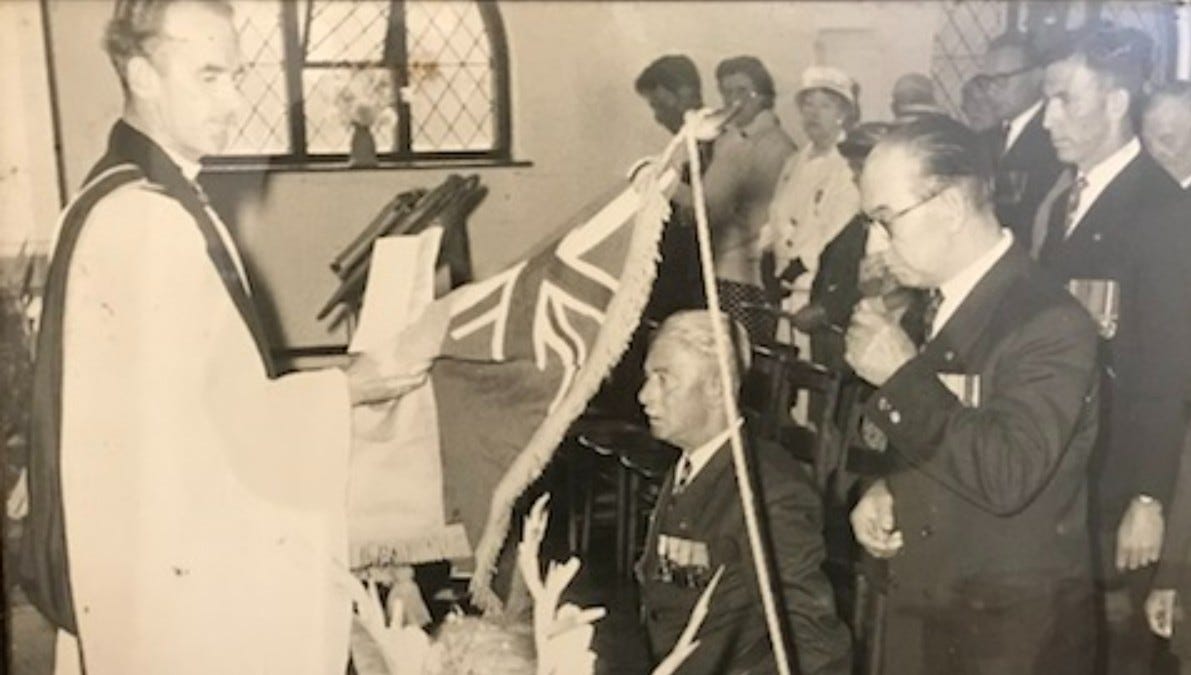
Savile hosted Speakeasy, a discussion program targeting teenagers which aired from 1969 until 1973. The producer for Speakeasy was Rev. Roy Trevivian, a religious man with powerful acquaintances and a cumbersome drinking problem. This wasn’t the only program that Trevivian was to produce for Savile. Another timeslot on BBC Radio was filled by a program called “Savile’s Travels”. The two Trevivian-produced programs aired one after another, and both programs saw Savile travelling to different locations. This continued until Trevivian’s drinking problem got the better of him, or at least that’s the official story.
Trevivian was busy while he was producing Speakeasy and Savile’s Travels. He appeared in a section of Malcolm Muggeridge’s “Jesus Rediscovered” which was also released in 1969. The same year Speakeasy began, some of his conversations with Malcolm Muggeridge also appeared in “What They Believe”, alongside conversations he had with comedian Spike Milligan, Zambian President Kenneth Kaunda, and the next Lord Chancellor, Quintin Hogg, and many others.
After the BBC finally accepted that they could no longer cover up Jimmy Savile’s litany of sex crimes targetting children, Dame Janet Smith DBE was commissioned to write a review in October 2012. In Chapter 7 of BBC Trust’s official review, under the title “Rumours, stories and jokes,” one rumour in particular is discussed, with the document stating:
“Jeff Simpson, a press officer in the 1980s and 1990s, heard that Savile had sex with young girls and also girls who were in hospital. He thought that the girls were “young” but did not know how young. He heard a story that Savile had been having sex with a young girl in the camper-van while the producer of Savile’s Travels was driving it. The producer, Ted Beston, denies the truth of that rumour. Mr Simpson also heard that Savile would invite girls back to his flat.”
This carefully contrived response to the allegations named Ted Beston as the producer of Savile’s Travels. However, Ted Beston took over as producer of Savile’s Travels after Roy Trevivian’s severe alcoholism had made his position untenable. The Dame Janet Smith Review was either incompetent or chose to ignore that Trevivian had also been the producer of Savile’s Travels. We can find evidence of Trevivian’s involvement in the program in question from a Daily Mirror article entitled “Savile’s Travels” from 9 January 1970, which states:
“Savile’s foray into academic life proves what a regular card he is. His radio programme fills one of the BBC’s religious slots and is produced by the Reverend Roy Trevivian, the BBC’s principal religious producer.”
The official BBC Review into Savile’s crimes appears ambiguous in places and purposely deceptive at times. Dame Janet Smith DBE had all the data and information available to her, yet they ignored Roy Trevivian’s involvement in Savile’s Travels.
The aforementioned BBC Press Officer, Jeff Simpson, elaborated on the story in section 7.37 of the review. Some of the language used within the review appears morally detached, lacking in social awareness and sometimes outright inappropriate, with the Smith review stating:
“Another story, which has a similar punchline, was told to me by Mr Simpson. He said that he had heard a story that the producer of Savile’s Travels had been driving Savile’s campervan while Savile was having sex with a girl in the back. They were driving to a civic reception. On the outskirts of the town, the van stopped and the girl got out. The van drove on a short distance and Savile stepped out of the van to be greeted by the Mayoress who welcomed him and thanked him for all the good work he did for children. As I have already said, the producer in question, Mr Beston, denies the truth of that variant of the story.”
The “punchline” Dame Janet Smith’s official BBC Review referred to was the sexual assault of a child. Regardless, there are a few occasions when Roy Trevivian is the Producer of Savile’s Travels, which fits the description of the event which Simpson describes. One of the related articles appeared in the Worthing Herald from Friday 2 July 1971, entitled “There’s nothing like a day by the sea, says those cheerful men,” which states:
“The Star and Garter party was accompanied by pop personality and disc jockey Jimmy Savile, and among those who attended a luncheon at the Assembly Hall were the Mayor and Mayoress, Alderman and Mrs S. M. Knight, a deputy town clerk, Mr T. L. Elliott, and Police Superintendent C. Cornbill.”
An earlier event which took place on 16 May 1969 was mentioned in the Harrow Observer under the title “Support for the Great Walk”. Charles Stenhouse, who was then Mayor of Harrow, wrote:
“The Great Walk will take place on Sunday, May 18 in aid of the various charities supported by walkers in Greater London. In connection I intend to be present at the Harrow check-point in Boxtree Road near its junction with High Road, Harrow Weald at 11 a.m. on Sunday, May 18 in order to hand to Mr. Jimmy Savile, the television personality, a sponsorship list headed by the Mayoress and myself and including the names of many members of the Council who are supporting the list in aid of Invalid Children’s Aid Association.”
There were many occasions when Roy Trevivian was producing Savile’s Travels, which fit some of the descriptions of the supposed “rumours, stories and jokes” told in Dame Janet Smith’s official BBC Review of Jimmy Savile’s criminal behaviour.
In 1972, a year before Savile’s Travels was discontinued, Roy Trevivian was still Jimmy Savile’s producer for the BBC Religious Dept. The program ran from 1968, and Ted Beston did not produce most of the series. It is astounding that someone as notoriously cryptic about religion as Jimmy Savile was chosen as the representative of the BBC’s key religious programs, and even those who worked with him navigated the proverbial Mulberry bush to avoid talking about Savile’s religious beliefs. In an article from January 1972 in the Liverpool Daily Post, Roy Trevivian is asked about Jimmy Savile’s religious beliefs. Trevivian told reporters:
“Let anyone start knocking Jesus to Jimmy and they soon end up with egg on their face.”
There Is No Hand Blacker
Jimmy Savile’s visits to Moscow haven’t been almost lost to time and tide for no reason. Savile’s history of systematic child abuse was finally revealed to the public by the same official entities which protected him, and soon the cover-up began. The BBC handed over certain information from the archives to the Metropolitan Police, and there were no attempts made to prosecute people based on that evidence. The BBC Review, conducted by Dame Janet Smith DBE, is rife with inaccuracies, falsehoods and misleading information. Yet, as always, the official review was designed to draw a line under the allegations rather than to discover the truth.
If a full independent review of Savile’s associations with official bodies had taken place, the truth would have shaken the Establishment to its core. When Savile started travelling to Moscow, there were also many other intelligence-backed missions to Moscow.
In 1961 the Editor of the Telegraph commissioned the eventual patsy of the Profumo Affair, Stephen Ward, to go to Israel to sketch participants in the Eichmann trial. Subsequently, it was suggested he should travel to the Soviet Union to sketch leading Russian politicians. Ward had trouble obtaining a visa from the Russian Embassy, and it was suggested he make contact with the Russian spy Yevgeny Ivanov, as the link might be useful. In 1963, Ward’s supposed suicide in custody also drew a line under the Profumo Affair.
Savile described the two weeks he spent in Moscow as the worst time of his life, and there is some suggestion that his run-in with the secret police was more significant than we may think. Savile was openly working for a known Western propaganda outlet, which was systematically targeting Russia with powerful cultural weaponry. Savile had to obtain a visa to travel to Russia and bemoaned the difficulty of this process, making it unlikely that the Soviet authorities were oblivious to his role as a state propagandist.
It was standard practice for Soviet authorities at the time to question those they suspected of spycraft on arrival in Russia. Savile even gave excuses as to why he stuck out like a sore thumb when he arrived in Moscow, but he doesn’t go into detail about the interaction he had with the secret police. Savile and his bodyguard were likely followed wherever they went in Russia. The admission that he was almost shot in a side street suggests that he was acting in a way which brought serious attention to him. But that was Jimmy Savile’s nature.
Originally, this article was going to be focused on Savile’s trips to Russia, but his significant connections to dancehalls led me down another path. The Black Hand series began in the nightclubs of the United Kingdom, and, whether you like it or not, Jimmy Savile pioneered the nightclub scene. The importance of the creation of DJ dance parties and dual turntables to the development of various musical genres cannot be overstated. The fact that Savile dressed in B-Boy style apparel 15 years before the image rose to popularity in New York is also notable. I have my tongue firmly in cheek as I refer to Jimmy Savile as the inventor of Hip-Hop. However, his influence on the music industry in general is often purposely ignored or played down in response to his prolific criminal behaviour.
It was also important to understand who was handling Savile during parts of his career, and Fr. Roy Trevivian’s involvement led me to discover significant inaccuracies within Dame Janet Smith DBE’s official BBC Review of Savile’s crimes. In hindsight, allowing the foxes to investigate the behaviour of their skulk is ridiculous, but that has become standard practice.
There is much more to be discovered about Jimmy Savile’s time in the nightclubs of the UK during this period. Savile had significant links to some of the main characters involved in the Profumo Affair. However, that’s another story for another time.






 NEWSPASTE
2 responses to “The Black Hand #8 – Comrade Savile, Inventor of Hip-Hop”
Loose change screen shots Your the man brother Amazing last show with hip hop back and forth on the wheels of steel Im still shook Bravo
Sent from ProtonMail for iOS
LikeLike
Update Yon in Japan not in Tulsa As a hill to die on – the trump event that can only be an act of God and turns the father of the wack scene into a golden calf is not the one Iâd choose And one theory is to get out of the darpa culling they will fake his heroic death setting his family up for a long political run Ending with the inbred red Barron Will see but you canât hide the warp bleed for much long God speed love you always know Im praying for you and our WHOLE HUMAN GENOME AS ONCE YOU REPLACE IT ITS NOT HUMAN ANY MORE
Sent from ProtonMail for iOS
LikeLike