

by Johnny Vedmore
Nahum Goldmann was one of the most influential Zionists of the 20th century. His life was one of stark political contradictions and allegiances, surreptitious high-level manipulation, and the creation of a form of modern Globalism adapted to political Zionism. This is the story of how the Zionist World Order was made manifest.
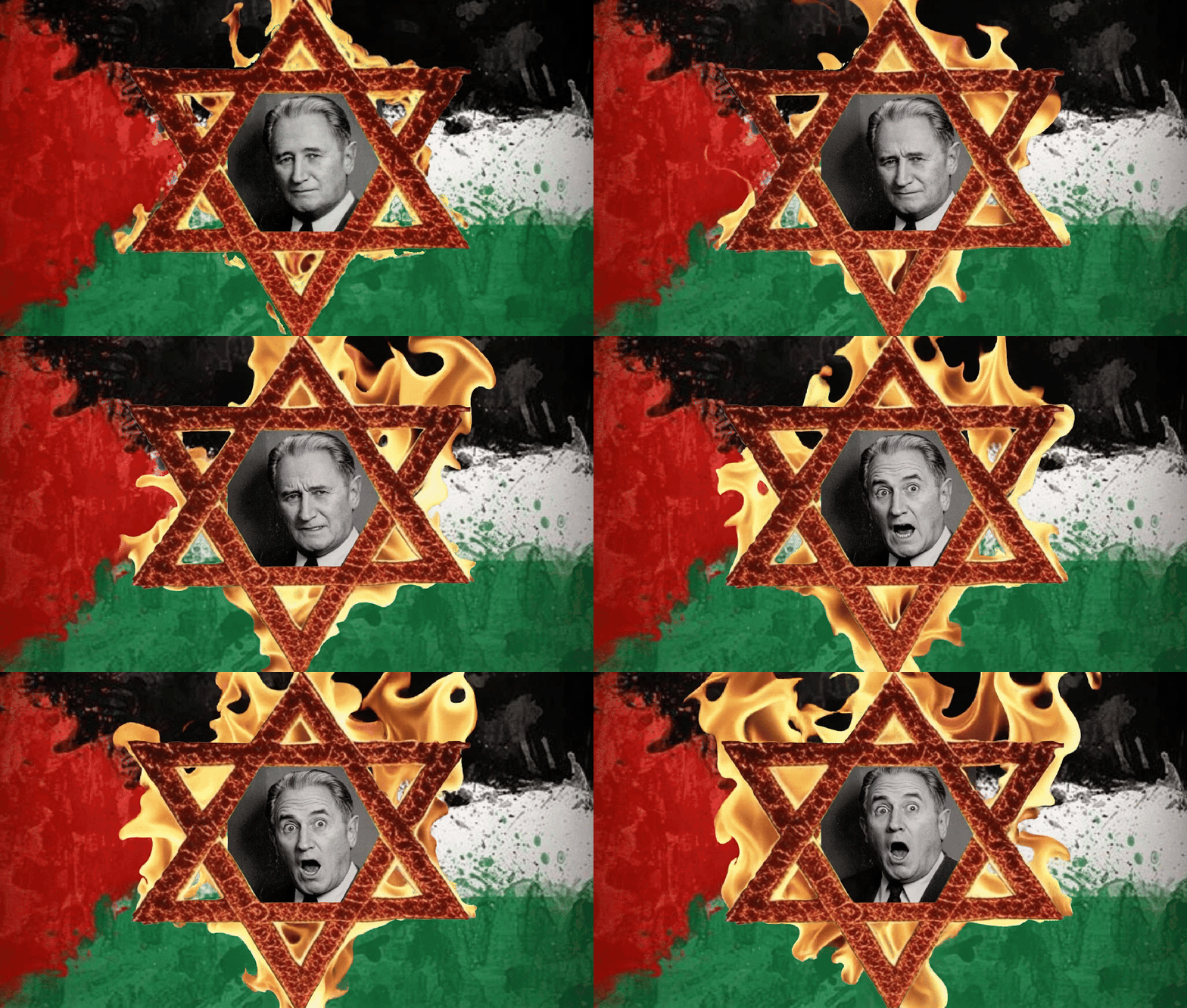
Nahum Goldmann was born in Belarus in 1895, then part of the Russian Empire. He was an avid Zionist from an early age, becoming the founder of the World Jewish Congress (WJC) and the president of the World Zionist Organization (WZO). Goldmann was a prolific Zionist organiser and commanded the front lines of the battle to create the State of Israel, eventually becoming one of the four main power brokers behind its creation.
In reviewing his story, we are not only able to better understand the evolution of Zionism as it relates to the Western Hemisphere, but we can also see the tactics which were deployed to achieve the Zionist agenda. Nahum Goldmann played a pivotal role in co-opting the early iteration of Globalism by infiltrating the United Nations just as it was forming, and, with powerful allies such as Eleanor Roosevelt and Chaim Weizmann, he helped create the paradigm of global conflict we see today in the Middle East.
Goldmann played many roles during his career; he wore many faces, and he influenced many Western politicians. However, except for Jewish historians and academics studying the rise of modern Globalism and international relations more generally, Nahum Goldmann’s significant impact on the world we now live in has almost been completely forgotten. In a previous article entitled: Guido Goldman, the CFR, and the German Marshall Fund, I also explored the extremely close relationship that Nahum Goldmann’s son had with Henry Kissinger and the deep state more widely. The relationship between Henry Kissinger and Guido Goldman saw the fruition of Nahum Goldmann’s vision of a world order with Israel as its centre point.
The Zionist Interlocutor
In the years leading up to World War II, Nahum Goldmann visited various nations surrounding central Europe in an attempt to lay the groundwork for his dream of a Jewish homeland while also warning world leaders about the seemingly unavoidable genocide of the Jewish people in Europe which had already been predicted many years before World War II.
In November 1936, a “wireless to the New York Times” confirmed that Dr. Goldmann, president of the Jewish World Congress, was in Yugoslavia to speak to the then regent, Prince Paul, to seek reassurance that the Jews of Yugoslavia weren’t to be targetted amidst a rise in antisemitic sentiment in the region. In April 1937, Nahum Goldmann was reportedly rallying support against the drafting of Romanian legislation, which he referred to as “a flagrant violation” of the previously enacted Romanian minorities treaty, which had been guaranteed by the League of Nations. The Romanian Fascist parties had supported the new law targeting the 5 million-strong minority community living in Romania, which included a Jewish population of around 1 million.
During this pre-World War II period, Nahum Goldmann was not only the head of the Jewish World Congress he was also the permanent Geneva representative of the Jewish Agency for Palestine, and it is because Nahum Goldmann was based in Switzerland during this period that his son, Guido Goldmann, was born in Zurich. Guido Goldmann became very important in his own right and was even one of Henry Kissinger’s closest friends from very early on. This closeness may have been due to Kissinger’s mother being Nahum Goldmann’s “kosher maid”.
Nahum Goldmann had become one of the leading public voices not only for the ideology of Zionism, but also for Palestine becoming the future home of the displaced Jewish people of Europe. In May 1937, Nahum Goldmann travelled to the Middle East to attend the opening of the “Pavilion of Israel in Palestine” alongside representatives of the British and French governments. At that event, Goldmann was recorded as the “Geneva representative” of the Jewish Agency for Palestine. Every room in the newly created Palestine Pavilion had been named after a different benefactor of the Zionist movement. Leading up to World War II, the Zionists intention to make Palestine the home of the Jewish people was clear to all nations with a stake in the region.
Nahum Goldmann spent the war years busily pushing the Zionist agenda across the proverbial finish line. During Hitler’s ascent to power, it had become clear to many ardent Zionists that once the war and the genocide of the European Jews eventually came to a head, there was likely to be no better time in history for Jewish leaders to argue for the creation of the state of Israel. Even though Britain intended to keep control over Palestine, the mandate they had was soon to come under intense pressure, and the extent and scale of the Jewish holocaust in Nazi Germany was to make the British rule of Palestine untenable.
The tensions between the Jews in Palestine and the British authorities were already on the rise, but during the war years, Dr. Goldmann was to call on Jews to fight alongside Great Britain against their common enemy. In March 1941, the New York Times reported Nahum Goldmann’s call to arms, quoting the Zionist leader as saying:
“Jews must regard themselves as allies of Great Britain and other democracies in this war and contribute their maximum as a fighting force.”
In that speech, given to a mainly Jewish congregation of Temple B’nai Jeshurun, located west of Broadway, Goldmann made the future intention of the World Jewish Congress clear, stating:
“Only in this way will they [Jews] safeguard their position in the coming peace and their claim to a position of having a voice in deciding their future as a people in the world.”
The position which the World Jewish Congress had already taken was to gain a significant stake in Palestine at the expense of the Arab people who populated the region. It is during these early years of World War II that the Arabs who inhabited Palestine started to realise that they were at great risk of becoming a secondary voice in the region. During this vital period in modern Jewish history, Goldmann toured the various temples and Jewish organisations to mobilise support for the creation of the Israel we know today. In fact, during October 1941, a mass transfer of Jews from Europe to the Holy Land was being predicted.
Nahum Goldmann and his associates weren’t only looking to create a Jewish homeland for the displaced Jews of Europe, along with other Zionist leaders; he was also helping them gain military training and arms. The New York Times reported that Nahum Goldmann and other Zionist leaders were arguing for the:
“Formation of an armed Jewish corps in the Near East to serve on a basis of equality with Britain’s other allies, and a denunciation of England’s “crystallization policy” which curtailed Jewish immigration to the Holy Land.”
By June the following year, representatives of 9 nations which had come under Nazi occupation had formed the “Advisory Council on European Jewish Affairs”, an organization which was affiliated to the World Jewish Congress office in New York. They pledged that the eventual freeing of their homelands from Nazi control would “carry with it a return of the freedom of their Jewish minorities.”
The heads of the 9 nations involved in the latter meeting included the exiled politicians of Latvia, Belgium, Czechoslovakia, and Yugoslavia, amongst others. The delegation also included Prof. Jacques Hadamard, a representative who was there on behalf of the delegation of ‘Free France’. Goldmann and other Zionists began to groom the potential future leaders of Europe who were living in exile during World War II. Nahum Goldmann’s World Jewish Organization and the World Jewish Congress were not the only Zionist groups working towards a new Jewish future. Goldmann’s organisations were also promoting such Zionist leaders as Yehudith Simchonith, who in 1942 was the Palestinian delegate to the Pioneer Women’s Organization.

The Zionist leaders had spent the 1930s and 40s setting up influential organisations designed to spread their ideology. Nahum Goldmann, although painted as a poor father figure who didn’t give enough attention to his young children, had a massive impact on his son’s life, with Guido Goldman eventually following in his father’s footsteps in this regard. Guido went on to found the German Marshall Fund of the United States at Harvard, which was responsible for cloning tens of thousands of other such influential non-governmental organisations with significant ties to the Central Intelligence Agency.
The Palestinian Problem
In October 1942, Nahum Goldmann was representing the executive committee of the Jewish Agency for Palestine, warning that the “…crucial moment for the realization of Zionism will be the immediate post-war period, perhaps even before a formal peace conference.” He was quoted as stating that it needed to be made “…clear to the United Nations, and, above all, to public opinion and the administration of the United States that these homeless, uprooted Jews cannot, after the war be sent back to their countries of origin where they will have no possibility of existence.” The latter statement was also made while he was the organisation’s representative to the League of Nations. In this capacity, he was also to forcefully signal the future Zionist policy towards the Arabs who inhabited Palestine during this period.
“There is no possibility of obtaining Arab consent to the establishment of a Jewish majority,” stated Goldmann during the aforementioned meeting of Zionist leaders, making it clear to the gathering that the intent of the Zionist leaders during the post-war years was to create a Jewish homeland through the mass settlement of displaced refugees. Goldmann referred to any discussions with the Arab leaders of the region about this matter as “completely unrealistic” and asserted that:
“…never in history has a people given up its position as a majority to another people, and in fairness to the Arabs nobody should expect them to do so.”
Goldmann and his Zionist colleagues were starting to set the groundwork for the obvious Arab resistance to come. Robert Szold, who was the vice-president of the Zionist Organization of America, was even more unequivocal in his tone on these matters, stating:
“Palestine as a whole must be recognized by the nations of the world as the Jewish homeland where Jews shall have unrestricted right of immigration and colonization, and where they shall be free to become the majority; the crux of the solution I prompt, large-scale immigration, going into millions if need be, as of right.”
At the same event where both Goldmann and Szold laid out their plans for the Zionist takeover of Palestine, Judge Morris Rothenberg, the former president of the Zionist Organization of America, stated clearly that:
“Zionism must now either offer a comprehensive solution commensurate with post-war Jewish need or the Zionist movement will pass into history as an interesting but an abortive attempt to solve the Jewish problem; and in so far as we can see, there will be nothing to take its place.”
This was a crucial period, one that was posed as a do-or-die moment for the Zionist movement as a whole. But the British were not so keen to capitulate to the Zionist demands and to give up their dominant position on Palestine and their rule over the Palestinian people, they had been carefully paying attention to the Zionist calls for a Jewish state in a land that the British colonial power had full dominion over.
In 1939, a Macdonald White Paper was drawn up in an attempt to close all further immigration to Palestine to prevent such a Zionist coup taking place, but, even though the British and Jews based in the region throughout the early years of World War II had become tentative allies, they were soon to be heading towards disagreement on the future of Palestine. It was to be the Americans who eventually forced Britain’s capitulation of Palestine.
By September 1943, Dr. Israel Goldstein of New York, who was president of the Jewish National Fund of America, was appointed as the president of the Zionist Organization of America during a meeting on September 12, 1943, in Columbus, Ohio. He was presented with $500,000 to aid a Palestine land drive by Mendel N. Fisher on behalf of the Jewish National Fund, which was to be used for “land redemption” in Palestine. Fisher announced that the money received for such projects at that time totalled $3,960,000—a sum valued at around $68,000,000 in 2024—and had been raised over just the previous eleven months alone. The Zionist movement was well organised, and when World War II came to an end, this preparation proved to be invaluable. As the true horrors of the holocaust in Europe became known, many of the Zionist leaders began preparing for the next stage of their plan.
In 1917, during the Great War, the British government signed the Balfour Declaration, a public statement announcing Britain’s support of a “national home for the Jewish people” in what was then Ottoman-controlled Palestine. Also, during World War I, Nahum Goldmann began working for a German intelligence and propaganda bureau linked to the German Foreign Office. The Nachrichtenstelle für den Orient, as it was referred to in German, focused on exploiting ethnic and religious nationalist groups within the Ottoman Empire as a means of pushing back against the increasing British and French influence. Working for German intelligence taught Nahum Goldmann a lot, but his loyalty to Germany became undone with the rise of Nazism. As it became clear that Germany was going to lose World War I, many Zionists in Germany began to push their agenda ahead of the priorities of the downtrodden German people. This led to a serious increase of animosity between Jews and Germans, something which was to bubble and fester throughout the decades to come.
While the Zionists in 1945 were discussing the post-war mandate of Britain in Palestine, the Balfour Declaration became central to this heated debate. The Zionists and Britain were heading towards an impasse over the issue of the Holy Land. In April 1945, the executive committee of the Jewish Agency for Palestine sent Stephen S. Wise alongside Nahum Goldmann to San Francisco to oppose any action that “would be inconsistent with or prejudicial to the special rights of the Jewish people under the Balfour Declaration and the Palestine mandate.”
By this time, the Arabs were becoming enraged by the concerted effort to displace their people in Palestine, something which had already been expected and planned for.
By December 1945, the Palestine Arab Council had rejected any cooperation with the Anglo-American inquiry into Palestine and demanded the withdrawal of the policy which Britain’s Foreign Secretary, Ernest Bevin, had enacted.
At this time, the Arab League consisted of 6 Middle East States and had adopted a more moderate view on the future of Palestine and the Arabs living within the region. The Palestine Arab Council began to resist the capitulation of Palestine, stating that Bevin’s policy: “Violates official British policy and overlooks Arab national rights and interests.” However, the Arab League rejected this stance and had, only a week before, publicly welcomed American entry into Palestine. The Zionist contingent had set up special offices at the relatively newly formed United Nations (UN) to lobby for Zionist interests, and Nahum Goldmann became the director of this specially created UN office.
The heads of the Zionist movement began a potent charm offensive towards the Americans, who were now perceived as the best chance of seeing the Jewish contingent taking large parts of Palestine for themselves. In January 1946, the New York Times reported:
“Dr. Nahum Goldmann of New York, chairman of the executive committee of the World Jewish Congress, praised the United States Army today for its handling of Polish Jews infiltrating the American Occupied Zone. “The United States Army has shown a remarkably sympathetic understanding of the reasons that are motivating these Jews to leave countries where life is intolerable for them and to try to reach the American zone, which has won a reputation as a haven for those suffering people,” Goldman said.”
Goldmann—spelt Goldman in many western newspapers during this period—had recognised that the Americans’ political detachment from the Palestinian region had made it more likely that they would side with the Zionist cause. The Zionist assumption was to be proven true as they began to direct the British and Americans into a clash over their individual policies in the region. By July that year, President Truman was accusing the British of taking military actions within Palestine without the knowledge or consent of their American allies. Within the same reports, the Jewish Agency for Palestine were accusing the British authorities in the region of “widespread terror’ directed against the Jewish population, including what they referred to as “the complete destruction” of Meshek Yagur, the largest Jewish settlement at the time in Palestine.
The Zionist propaganda battle was complex and rife with emotion. The British were accused of “the herding of whole Jewish male populations into British concentration camps”. This heated and emotive rhetoric, with the Jewish Holocaust of Europe still very fresh in the minds of all these nations, left the British with a losing hand.
It is during this period that four Zionist leaders in particular began to openly lobby the Americans on behalf of the Jewish Agency for Palestine; Rabbi Stephen S. Wise, Dr. Nahum Goldmann, Louis Lipsky and Rabbi Abba Hillel Silver were soon to ask Truman to intervene to prevent “the destruction of generations of labor and achievement of Jewish pioneers and builders.” Truman acted swiftly, putting a joint resolution before the Senate and the House of Representatives to “withhold American recognition of Trans-Jordan as a unilateral British violation of the Convention on Palestine as well as Article LXXX of the United Nations’ Charter”.
The British were on the back foot, and their actions were beginning to be portrayed by the Zionists as akin to those of Hitler. Britain attempted to control the spread of this propaganda in the region itself by barring the creation of Palestinian visas for Dr. Stephen Wise and Louis Lipsky, but, in reality, the British were all but defeated. The Zionist leaders would soon use the United Nations to drive the dagger home. They began to argue for what they called the “fair partition” of Palestine. However, the Zionists’ definition of a “fair partition” was to see the newly created kingdom of Trans-Jordan get an area of land with a 600,000-strong Arab population, while the rest of the region was to become a free state under Zionist leadership. The latter area of Palestine consisted of 700,000 Arabs and around 600,000 Jews, with plans to increase the Jewish population to around 1,500,000 soon after. But even the Americans at this stage found the partition of Palestine too much to swallow as a solution to what all parties involved often referred to as the “Jewish problem.”
Official resistance to the creation of the State of Israel under the control of the most prominent Zionist leaders was soon to dissipate. On 14 May 1948, the declaration which officially created modern Israel was made and Dr. Chaim Weizmann, the former president of the World Zionist Organization, became the de facto head of state until his election as President of Israel on 17 February 1949.
The Formation of Zionist-Aligned Globalism
The Goldmann residence in New York was a veritable thoroughfare for the American elite, with various famous international and American politicians, philosophers, socialites and others coming to bend the knee in honour of Nahum Goldmann. In the post-war world, they all recognised Nahum Goldmann as one of the founding fathers of modern Israel. Visitors to the residence included Pianist Arthur Rubinstein, philosopher Isaiah Berlin, Seagram’s Samuel Bronfman, and Israel’s first president, Chaim Weizmann. Politicians intricately involved with the creation of the United Nations also frequented the Goldmann household. The UN Secretary General Dag Hammarskjöld, and influential figure at the early UN, Eleanor Roosevelt, were regular visitors. Herbert Lehman, a Democratic politician and co-owner of Lehman Brothers, was another influential friend.
Nahum Goldmann’s relationship with Eleanor Roosevelt was vital to achieving his desired aims. She had helped Goldmann obtain an office at the United Nations, especially to lobby members for the creation of the Israeli state. The Palestinians did not get such an opportunity.
The Goldmann’s bustling house eventually saw a visit from the first Chancellor of West Germany, Konrad Adenauer, too. Goldmann had travelled to London to meet with the West German Chancellor Konrad Adenauer in his capacity as president of the Conference on Jewish Material Claims against Germany. There, he received the statement from Adenauer, which read:
“The honor of the German people requires it to do all it can to compensate the Jewish people for the injustice done to it.”
Nahum Goldmann had not only helped to create Israel, but he was also a key part in the reparations process between Germany, the Jewish people and the State of Israel itself. In the book, “The Seventh Million: The Israelis and the Holocaust”, author Tom Segev writes of some of the negotiations in which Nahum was involved during this period, stating:
“When the Israeli and Jewish representatives walked out of the formal negotiations, Nahum Goldmann’s great hour as a lobbyist and manipulator began. Goldmann organized and coordinated a worldwide network of activities aimed at persuading the Germans that it was in their best interests to reach an agreement. As part of this effort, he monitored, and even took part in, the ceaseless haggling in Bonn. He went to see cabinet ministers, senior officials, and members of parliament, making his way through the corridors of power and into the inner chambers. He saw everything and heard everything. He plotted intrigues. He shared secrets with supporters, thwarted opponents, collected promises, made threats: a man of a thousand faces.”
However, it wasn’t only Eleanor Roosevelt, Chaim Weizman, Dag Hammarskjöld and Konrad Adenauer who made up Goldmann’s contact list. In Nahum Goldmann’s 1978 book, “The Jewish Paradox”, he speaks of the many Jewish statesmen he had become close to throughout his life, stating:
“I have had the privilege of knowing several Jewish statesmen personally—men like Léon Blum, Henry Kissinger, Pierre Mendès France, Bruno Kreisky and others—and good patriots as they have been and are in their respective countries.”
One of those aforementioned statesmen in particular, Henry A. Kissinger, was not only a great influence on Nahum’s son Guido Goldmann, but they quickly became life-long friends and even shared a bachelor pad together.
Why Palestine?
Nahum Goldmann was painted with many brushes throughout his life. However, those who understand his impact on the world are often in reverence and awe of his many achievements. The instability we see today in the Middle East was beneficial to the Western deep state Establishment that grew out of World War II. The turmoil was designed by a small group of intelligence-linked actors who wanted to create a paradigm of perpetual limited warfare, which would benefit one group of people in particular. You may think I’m referring to the Jewish people as the potential benefactors, but instead, I’m referring to those who look to create order out of chaos.
American hegemony has been built by those who systematically create chaos and then fill the vacuum with their kind of order. The Jewish state was formed out of the fires of global conflict, and it’s likely that it will collapse under similar pressure.
Nahum Goldmann was described as a statesman without a state. He declined top positions in the Israeli government and never officially represented the State of Israel. However, surreptitiously, he was Israel’s number one negotiator; he was crucial in entangling the goals of Zionism and those of Globalism, and, without him, the State of Israel today may not exist.
Following World War II, the displaced Jewish people of Europe could have settled in a number of countries. Regardless, the decision to place them in Palestine has caused continuous conflict, trauma and tragedy ever since. Palestine was chosen as the home of Israel for various reasons. Of course, there were significant historical links to the region for many Jewish people, but the main logical reason for Zionists targeting Palestine was the rise of modern Globalism. Leaders such as Nahum Goldmann knew that Palestine was on the crossroads of the world, and they knew the world was becoming smaller and more interlinked. The Academics were predicting a globalist world of tomorrow, and the Zionists wanted to make Israel the centre of that new world order, which was emerging from the most brutal war in human history.
I will leave you with a quote by Nahum Goldmann from a Montreal-based newspaper entitled l’Unite Nationale from 4 November 1953:
“The Jews might have had Uganda, Madagascar and other places for the establishment of a Jewish fatherland, but they want absolutely nothing except Palestine; not because the Dead Sea waters by evaporation can produce five trillion dollars worth of minerals and powdered metals, not because the sub-soil of Palestine contains 20 times more petroleum than all the combined reserves of the two Americas, but because Palestine is the Crossroads of Europe, Asia and Africa, because Palestine constitutes the veritable center of world political power, the strategic military center for world control.”






 NEWSPASTE