
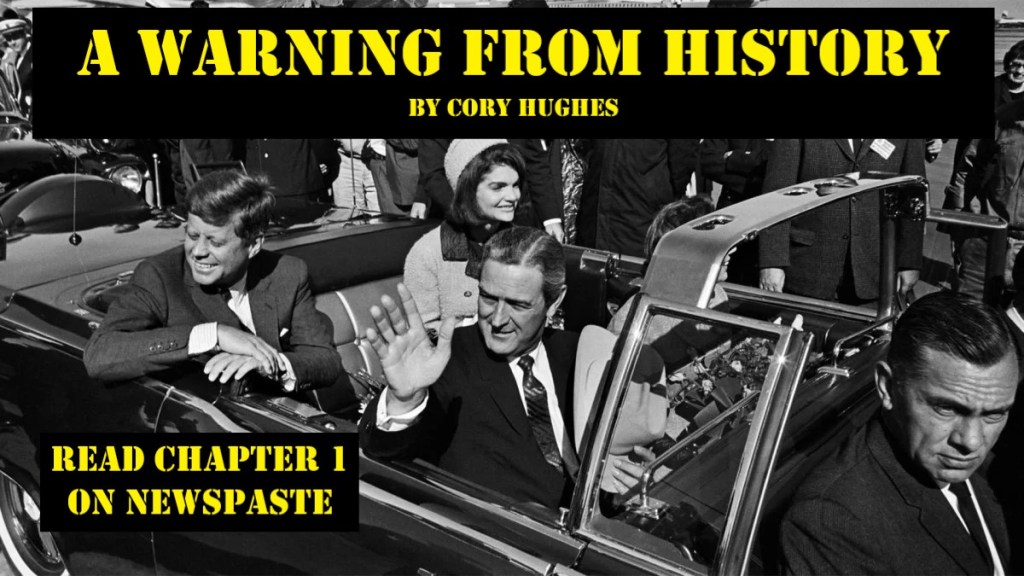
CHAPTER 1 Oswald
I never meant for Oswald to become a theme of this book. In as far as the mechanisms of the assassination go, Oswald is completely irrelevant. While he is seemingly the key figure in the story of the Kennedy assassination, the preponderance of evidence tells me something quite different.
The official story tells us to believe that Oswald was a disgruntled marine who was obsessed with communism; that he defected to the Soviet Union; that he bought a rifle and killed the President of the United States on that fateful day in Dallas. However, when you actually take the time to examine the individual incidents that were strung together in order to paint this picture of a homicidal Marxist, none of them stand up to even the slightest amount of scrutiny.
There are hundreds of examples of Oswald leaving his angry communist footprint across New Orleans, Dallas, Mexico City, and elsewhere. As I began to peel back the layers of the onion and examine each of the incidents that have been used to demonstrate that Oswald was a loner and a communist, I ran into a problem; Oswald was nowhere to be found.
I am going to layout a number of occurrences that are alleged to have involved Lee Harvey Oswald. These occurrences allegedly provide the evidence that Oswald was a dissident, and when looked at in their totality, should make the case that Oswald assassinated the President. Many Americans hated Kennedy because he was perceived as being soft on communism, yet he was killed by an alleged communist. Does that really make sense? In all these years, no one has been able to present a theory of the crime that provides a viable motive for Oswald to want Kennedy dead. You are simply told to accept this fiction as reality. The notion that Oswald killed Kennedy is one that many have accepted. If you don’t dig too deep, the story as presented to us appears to be rational and somewhat plausible. In reality, the thesis of Oswald as the lone assassin is a well thought out and long planned cover story that was designed to create plausible deniability for those involved. The assassination was the most significant event in world history and the perpetrators prepared accordingly. In the end, Oswald was, just as he had told us, a patsy.
One researcher who dedicated his life to investigating Oswald and all of the alleged interactions with him that led to the mainstream narrative was John Armstrong. He spent over ten years on his investigation which culminated in his book Harvey & Lee. I must address Armstrong’s successes, but more importantly his failures. To summarize his work, Armstrong concluded that Oswald had a duplicate beginning sometime around 1947. He believed that the Oswald story was actually a mingling of these two men’s lives. Armstrong provided compelling evidence that there were two Oswalds who both utilized Lee Harvey Oswald’s credentials from the time he was a child through the end of his life. According to Armstrong one of them went by Lee and the other went by Harvey.
On the surface, it seems preposterous, however, the data that Armstrong presented in the form of first-hand interviews and document releases, could not be more convincing. The data he put forth is undeniable. There are countless incidents in Oswald’s life presented by Armstrong that just don’t fit with what we think we know about Oswald and his history.
In 1953, there were numerous conflicting records pertaining to Lee’s education. It is well documented that Oswald attended P.S. 44 in the Bronx, New York. He was admitted on March 23, 1953, and had a positive attendance record until he left the school in January of 1954. The documents from P.S. 44 are posted on Armstrong’s website [Link]. It is during this time period that the official story describes Oswald as a truant, having numerous court appearances, and counseling with psychiatrists which ultimately resulted in the placement of Oswald in a boys home called Youth House.
In May of 1953, Oswald’s health records from P.S. 44 indicated that he was 5’4” tall and weighed 114 pounds. In April of that same year, just one month prior, Oswald had been interviewed at Youth House by Dr. Renartus Hartogs and Dr. Milton Kurian. Oswald’s height was estimated to be between 4’6” and 4’8”. Dr. Hartogs described Oswald as appearing gaunt and malnourished. He stated that Oswald was “reminiscent of children he had seen in concentration camps in Europe” [John Armstrong, The Early Lives of Harvey and Lee, Link ]. This description does not match what we see in the known photographs of Lee from that time period.
In September of 1954, after Oswald left New York for New Orleans, he began the ninth grade at Beauregard Junior High while living at 126 Exchange Place. There are mountains of documentation showing this to be accurate. At the same time, however, Oswald was attending Stripling Junior High in Ft. Worth, Texas and he was living at 2220 Thomas Place, directly across the street from the school. This address is also the address that Marguerite Oswald was allegedly residing in at the time of the assassination. Oswald’s attendance at Stripling was confirmed by Frank Kudlaty, the school’s Assistant Principal.
Kudlaty told Armstrong in a videotaped interview that he had been contacted by the school Principal, Mr. Wylie, the day after the assassination. On November 23, 1963, he was told to report to the school and pull all records for Lee Harvey Oswald. He was advised that men from the FBI would be meeting him there to retrieve them. Kudlaty located the records, gave them a cursory glance to confirm that they did belong to Oswald, and then turned them over to the FBI. These records indicated that Oswald had attended the school for a six-week period at the beginning of the 1954 school year. This conflicts with the records from Beauregard where he was present throughout the entire year.
Oswald’s attendance at Stripling was also confirmed by a fellow student, identified as Francetta Schubert. Schubert was a year behind Oswald, but she remembered him clearly. She was even able to point out to Armstrong the house on Thomas Place in which Oswald had lived. She stated that she had seen him walk home from the school numerous times.
Armstrong obtained an interview with Myra DaRouse, a teacher at Beauregard Junior High in New Orleans, who knew Oswald well. DaRouse confirmed Oswald’s attendance at Beauregard during the same time period. She told Armstrong that he never went by the name Lee and that he was always known as Harvey. It was when I watched this interview with DaRouse that I actually started to take Armstrong’s work seriously. The notion of a Harvey Oswald and Lee Oswald, as two separate individuals, was no longer just a fanciful take on hard-to-explain circumstances. I had known he was onto something, but watching the complete series of interviews conducted with Kudlaty, Schubert, DaRouse and Kurian, solidified Armstrong’s work in my mind.
Since first coming to accept Armstrong’s work as a plausible explanation for all of the conflicting information regarding Oswald’s youth, I have concluded that this duplicate Oswald scenario and Lee’s false defection to the Soviet Union were inextricably linked. After reading Armstrong’s book and examining all of his work, I believe I can state with certainty that Oswald’s brother Robert most certainly had been involved with the CIA at some level, and that he was completely aware of and in on this duplicate Oswald scheme.
While it seems ridiculous, you have to ask yourself, at the height of the cold war, what was the United States government, via the CIA, willing to do to get a spy into the Soviet Union? The answer is, just about anything. When you truly come to understand tradecraft and how covert organizations operate, you realize that the use of body doubles and other forms of misdirection are simply modus operandi. Spies live in a world of deception and intrigue. Do you really find it outlandish that a post-World War II CIA would pluck a Russian-speaking child out of an impoverished eastern block country, or maybe even a concentration camp, then raise him in the US under the name of another child for the purposes of later infiltrating him back into the Soviet Union? Of course, they would. This is what spies do. If they didn’t attempt something like this, I would be extremely disappointed in their lack of initiative.
Armstrong was not the only person who believed that Oswald was being impersonated. One of the earliest advocates of this idea can be credited to J. Edgar Hoover himself. In a June 3,1960 memo to the Office of Security at the State Department, Hoover states the following: “Since there is a possibility that an imposter is using Oswald’s birth certificate, any current information the Department of State may have concerning subject will be appreciated.” By summer of 1960, the FBI was already on to the fact that Oswald was being impersonated.
I find Armstrong’s data to be credible and I believe it provides us a rare glimpse into the mind of our intelligence community regarding their tactics during the cold war that will never be found on any unclassified document. The problem with Armstrong’s work is not in the data he collected, but in the conclusions that he drew from that data. Armstrong attributed all of the Oswald imposter actions between the time of the initial defection to the Soviet Union and the assassination to “Lee,” while “Harvey” was being set up to take the fall. This is where Armstrong crashed and burned.
Armstrong was never able to connect the dots on who was actually impersonating Oswald after his defection, even though their names are scattered throughout the Kennedy literature. The evidence overwhelmingly points to two men in particular, who posed as Lee Harvey Oswald, in order to create Oswald’s communist persona in the years leading up to the assassination: William Seymour and Kerry Thornley. There were a few other minor characters who had used the name Oswald as part of the frame-up but none of them contributed to the major events that we’re all familiar with in the Lee Harvey Oswald story. I will admit, I have no idea what to do with Armstrong’s Harvey & Lee premise once Oswald leaves the marines. It is from this point forward that the actions attributable to a duplicate Oswald or Oswald imposter provably fall on individuals outside the scope of Armstrong’s research.
Garrison investigator Louis Ivon compiled a list of Oswald’s various heights from either first hand descriptions or documents. Ivon sent a memo to Garrison on November 14, 1968 detailing these discrepancies as well as his conclusions on the idea that there were multiple Oswalds. Pricilla Johnson, the journalist who knew Oswald in the Soviet Union, described Oswald as 5’11. Kerry Thornley described Oswald as 5’5” and 140 pounds. Oswald put on his application for the Albert Schweitzer College the he was 5’11 and 160 pounds, which is close to how he was described by Marguerite Oswald at 5’10”. When Oswald returned to the states from the Soviet Union, his paperwork indicated he was 5’6” and ‘slim.’ Oswald’s passport indicated a height of 5’11, yet as Ivon points out, photos of Oswald with Marina in Russia do not depict a man “towering over” a tiny Marina who was just over 5 foot tall.
“So we have a 5’6″ OSWALD coming back to the U.S., going to ROBERT’s house at Fort Worth, and growing 5 inches in time to be observed by JOHN FAIN 13 days later! If you really want to know what I think, it is that ROBERT knew this returning defector was not really LEE and this ..is what his problem was the night of the assassination when he found it necessary to take such a long drive to think things out…My guess is that the impersonation started in the Marines. – KERRY THORNLEY said the OSWALD he knew was about 5’5″, so let’s say that he knew the LEE HARVEY OSWALD who went into the Marines as 5’8″ (but looked smaller) . Bill Boxley (sp?) said that the CIA has successfully put over impersonations so that even mothers are fooled”
[Weisberg Files, Louis Ivon Memo to Jim Garrison, November 14, 1968].
The Oswald story that the world has been told revolves around the notion that he was a communist. We are led to believe that communism was the driving force in his life. All of the actions he took, from joining the Fair Play for Cuba Committee, to defecting to the Soviet Union, could be traced back to his fascination with Marx and the plight of the worker. At no time did Oswald ever deny this, nor did he deny his activities on behalf of the FPCC. We even have him on film handing out leaflets for the New Orleans chapter that he himself had allegedly started. These acts make the case presented to us a slam dunk, right? But what if Oswald was not a communist? What if he was an intelligence agent? Wouldn’t that completely undermine the government’s narrative?
There are many indications that Oswald’s defection to the Soviet Union was part of a false-defection program being run by the CIA. He had left the marines on what is called a dependency discharge, meaning he was allowed to exit his military service in order to care for his injured mother, Marguerite Oswald. Marguerite was many things, but injured was not one of them. She was not in need of permanent care. After being discharged, Oswald spent a mere three days with her before departing for Europe, allegedly to attend the Albert Schweitzer College in Zurich, Switzerland. Oswald failed to arrive in Zurich, instead heading to Helsinki, Finland. Once in Helsinki, Oswald was able to obtain a visa to enter Moscow in record time. It only took one day for Oswald’s visa application to be approved instead of the week or more it should have taken. Oswald’s stated intent, to attend the Albert Schweitzer College, was apparently a cover for his true intentions. He had applied to the school and had been accepted, which gave his story credibility, but why did he choose that particular school? According to Bill Simpich in his February 11, 2018 article THE JFK CASE: THE TWELVE THAT BUILT THE OSWALD LEGEND (Part 2: An Instant Visa Gets The Marine Into Moscow),
“Percival Brundage, the college president, was Eisenhower’s budget director and a staunch advocate of black budget financing for military and intelligence operations. Brundage is also known as one of the two owneroperators of Southern Air Transport, infamous as the “CIA’s airline” in the Caribbean and in Southeast Asia during the 60s and 70s.”
It would apper that the Albert Schweitzer College, if not an outright front, had direct connections to the CIA. While the school cover story was just one minor step in the process of Oswald’s defection, it shows that even the minor steps he took to get to the Soviet Union are marked with the fingerprints of intelligence.
At the same time Oswald was making his way to Moscow, CIA false-defector type programs were already active. Declassified documents show that the program codenamed AEBALCONY had been in-place since 1959, and executed between 1960-1962. The idea was to utilize naturalized US citizens with fluency in Baltic languages to conduct “mounted” and “piggyback” operations involving commercial travel to Estonia, Latvia, and Lithuania, which were under Soviet control. Upon arrival, operatives would attempt to make new contacts in the area who would be willing to work with the US in gathering and relaying intelligence [GlobalSecurity.org, Soviet Russia – Redbird/Redsox, Link].
A July 25, 1960 CIA document states, “Project AEBALCONY will support legal travel operations utilizing U.S. citizens and targeted at the Estonian, Latvian, and Lithuanian USSR.” [AEBALCONY, Archive.org, Link]. By support they meant financial support. Is this how a penniless Oswald was able to pay for his journey across the Atlantic?
AEBALCONY was connected to another program called REDSKIN, which had been in existence since at least 1955. REDSKIN was built on the same foundation as AEBALCONY, however, it specifically aimed to utilize students who would gather intelligence and report back what they have observed. By 1961, the CIA planned to refocus efforts on REDSKIN, which had been reorganized under the AEBALCONY program. Other programs under AEBALCONY included AEPOLE, AEFLAG, and AEBASIN. The documents that have been released on these programs show that they had already selected candidates, and in some cases deployed them, however, many of those recruited failed to be utilized for various reasons [archive.org, AEBALCONY Quarterly Report November 9, 1961, Link].
There is no direct evidence that Oswald had been a participant in these programs, however, the aims of these operations, as written in the unclassified documents pertaining to AEBALCONY, match many of the circumstances surrounding Oswald’s defection. Could the Albert Schweitzer College affair link Oswald to REDSKIN? It’s possible. As the program specifically utilized naturalized Baltic language speakers, if Oswald had been part of one of these programs, it would lend credence to Armstrong’s theory that Harvey Oswald was sent to Russia due to his fluency in Russian. As you can see, there are a lot of ifs here. These pieces of the puzzle appear to fit, but unfortunately I don’t think we’ll ever have enough evidence to say conclusively that Oswald was part of these19programs. If one was to speculate on the issue, however, his involvement in these programs would answer many of the questions surrounding Oswald’s defection.
Oswald returns to the US in June of 1962. With him is his Russian wife, Marina, and their first child, June. They live in the Dallas-Ft. Worth area of Texas. It is here that Oswald connects with Ruth and Michael Paine, and George De Mohrenschildt, who undoubtedly played major roles in his setup and in the construction of the myth that Oswald was a communist.
The myth was enhanced by many of Oswald’s actions, however, it was his alleged affiliation with the Fair Play for Cuba Committee that has been emphasized in the official story, and is largely perceived as the most damning evidence that he was a communist. Oswald is alleged to have contacted the FPCC and sought assistance in establishing the New Orleans chapter of the group. The letters he sent the organization clearly link him to the FPCC. He was also captured on film distributing leaflets for FPCC on the streets of New Orleans. This led to his appearance on WDSU-TV New Orleans, where he proudly proclaimed he was a Marxist-Leninist. There isn’t much more damning evidence of his communist leanings than that. But what if the FPCC was never actually a communist organization? What if their roots could be determined to have been in US intelligence? What if Oswald was never actually associated with them at all?
The following excerpt from the FPCC Wikipedia page [Link] is the only information the site provides. There is no mention of Oswald, Kennedy, or anything else for that matter.
“The FPCC’s purpose was to provide grassroots support for the Cuban Revolution against attacks by the United States government, once Fidel Castro began openly admitting his commitment to Marxism and began the expropriation and nationalization of Cuban assets belonging to U.S. corporations. The FPCC opposed the Bay of Pigs invasion of 1961, the imposition of the United States embargo against Cuba, and was sympathetic to the Cuban view during the Cuban Missile Crisis of 1962. Its members were placed under surveillance by the FBI.”
This explanation does everything it can to neatly sweep the real history of the FPCC under the rug. Note the phrase, “once Fidel Castro began openly admitting his commitment to Marxism.” That phrasing ignores the origins and operations of FPCC prior to Castro’s turn to communism. The FPCC was formed in April of 1960, yet Castro did not embrace communism until December 1961. What are we to make of this discrepancy and what was the purpose of FPCC is if was not to support Castro’s communist regime?
If you visit the FPCC Wikipedia page and copy the URL into the Wayback Machine at archive.org, you will find a completely different account of how the organization was started. It credits Vincent T. Lee with its formation. The snapshot of the website dated January 21, 2005, states the following:
“The Fair Play for Cuba Committee was an activist group set up in the United States in early 1960 by Vincent T. Lee. Its purpose was to provide grassroots support for a movement to modify to support the Cuban Revolution against attacks by the United States Government once Fidel Castro began openly admitting his commitment to Marxism and began the expropriation and nationalization of Cuban assets belonging to U.S. corporations. The Committee opposed the Bay of Pigs invasion of 1961, the imposition of the United States embargo against Cuba and was sympathetic to the Cuban view during the Cuban Missile Crisis of 1962. The main current interest in this group is that its most visible member in the New Orleans, Louisiana area was briefly Lee Harvey Oswald, later the accused assassin of President John F. Kennedy.”
This is a far cry from the current Wikipedia explanation of FPCC. By May of 2006, the same Wikipedia url had removed all mention of Vincent T. Lee as having formed the organization and credited no one with its inception. Wikipedia, despite their humble origins, has turned into a propaganda outlet. In recent years they have been on the frontlines of the government’s efforts to rewrite history.
The real story of the FPCC begins with Robert Taber and Richard Gibson. Both men were active journalists for CBS when they formed the organization in April 1960, however, they were not publicly linked with the founding of the group until fairly recently. Vincent T. Lee had been credited with forming the organization in Tampa, Florida, which is provably false. The obfuscation over the origins of FPCC likely stems from the fact that Gibson and Taber worked for the CIA and FPCC was most certainly a CIA front organization.
For reasons unknown, Richard Gibson had been intentionally or unintentionally outed as a spy in 2005 through one of the JFK records dumps. The following comes from an article by Jefferson Morley published in Newsweek on May 15, 2018 [Jefferson Morley, CIA Reveals Name of Former Spy in JFK FIles – And He’s Still Alive, May 15, 2018, Link];
“In a strange twist, on April 26, when the National Archives released thousands of documents pertaining to the assassination of President John F. Kennedy, they included three fat CIA files on Gibson. According to these documents, he had served U.S. intelligence from 1965 until at least 1977. This was well after Wright wrote his book, and it’s not clear if Gibson had engaged in espionage before that period. But his files revealed his CIA code name, QRPHONE-1; his salary (as much as $900 a month); and his various missions, as well as his attitude (“energetic”) and performance (“a self-starter”).”
Taber’s background isn’t much different from Gibson’s. He fought in the war, which is most likely when he was recruited by intelligence. If you had half a brain, you were snatched up by the O.S.S. almost immediately. People underestimate how much power and control the O.S.S. had over the direction of the war, and over the US government itself. Between 1941 and 1945, the O.S.S. recruited tens of thousands of operatives. After the war, all of these operatives went home and got jobs in every possible sector of the workforce. Then, in 1947 when the CIA came into existence, the majority of those recruited came back into the intelligence fold covertly. I suspect that this is what happened with Taber. If that is not the case, then he and Gibson were most certainly brought in under Operation Mockingbird in the 1950s.
According to Jeffrey St. Clair and Alexander Cockburn’s November 2016 article appearing in Counterpunch titled, The CIA and the Press: When the Washington Post Ran the CIA’s Propaganda Network;
“By 1953 Operation Mockingbird had a major influence over 25 newspapers and wire agencies, including the New York Times, CBS, Time. [Frank] Wisner’s operations were funded by siphoning of funds intended for the Marshall Plan. Some of this money was used to bribe journalists and publishers.”
By the time the Fair Play for Cuba Committee was created in 1960, the CIA owned the American media. Gibson and Taber were no exception, especially when you consider the fact that they were both working for CBS.
Allegedly, after Castro’s alignment with the Soviets and his embrace of communism, Gibson and Taber denounced the Fair Play for Cuba Committee which was handed off to Vincent T. Lee. It was allegedly at this point in 1962 that Gibson and Taber offered themselves to the CIA. According to Spartacus Educational;
“Robert Taber resigned from the FPCC in February, 1962. The following month he was interviewed by the CIA and FBI (19th March). He was never charged with any offense but according to Bill Simpich: “Many people claim that Taber had gone over to the CIA at this point. The real question is more subtle – it isn’t whether he asked to be an informant, but whether his offer was ever accepted.”
[Spartacus Educational, Fair Play for Cuba Committee, Link].
If you actually believe that Taber and Gibson started the FPCC out of the goodness of their hearts and not at the behest of the CIA, I have a bridge to sell you. This is a CIA cover story and a pathetic one at that. I would suggest that after Castro turned communist, the CIA saw that continuing the FPCC as a pro-communist organization would be a way to keep tabs on Americans who were Castro sympathizers in the vein of COINTELPRO. At the same time, they needed to exfiltrate their agents from the organization allowing them to save face.
On September 8, 1976, an article was printed in the Tampa Tribune titled [Vincent] Lee, Oswald Got Together On Cuba Travel by Tony Durr and Skip Johnson. The article alleges that Vincent Lee, whom it stated was the “founding father” of the FPCC, had exchanged a series of letters with Oswald. It also alleges that Vincent Lee had supplied Oswald with an FPCC membership card that was later found to have Lee’s signature on it. After the assassination, the FBI claimed to have requested all correspondence from Lee, that he may have had with Oswald. The FBI’s position is that he turned over six letters which were entered as commission exhibits. The article also stated, unequivocally, that Oswald and Vincent Lee had met in person in Tampa, Florida in order to plan Oswald’s trip to Mexico City, however, the meeting in Tampa was long after Oswald’s alleged trip to Mexico City.
According to Gary Hill in his 2021 article, The Nixie Nexus;
“A very reliable FBI undercover asset Joe Burton, reported that on November 17, 1963, that Oswald visited Tampa and attended a Fair Play for Cuba Committee meeting and met with a key member of the FPCC.”
Several others witnesses including Frank Sturgis claim to have seen Oswald in Florida that weekend, however, it is also claimed that Oswald was meeting with anti-Castro Cubans in Austin around the same time [Gary Hill, The Other Oswald, The Nixie-Nexus, April 19, 2021, Link]. One thing I can tell you with certainty is that if Frank Sturgis claimed to have seen Oswald that weekend, it most certainly was not Oswald. Sturgis was close friends with another man whom I will later demonstrate had often been mistaken for Oswald; William Seymour. Seymour and Sturgis are captured together in a famous photo depicting them at a table with other members of Alpha 66, an American/Cuban hit squad that was being overseen by Sergio Arcacha Smith with the support of the CIA. I’d be more inclined to believe that Santa Claus attended that meeting before I’d believe it was the real Oswald.
In regards to the communications between Oswald and Vincent T. Lee, Vasilios Vazakas wrote in his essay, Creating the Oswald Legend – Part 3;
“On August 1, 1963, Oswald wrote a letter to Vincent Lee informing him that he had opened the P.O. Box and distributed leaflets on the streets. Then he wrote something bizarre, but prophetic, saying to Vincent that some exiled Cubans attacked one of his demonstrations, the police intervened, and because of that he lost any support and was left alone.”
The incident Oswald is referring to in his August 1st letter is obviously the disturbance between himself and Carlos Bringuier in front of the International Trade Mart. This incident led to Oswald’s arrest and subsequent interview on WDSU-TV New Orleans. The problem here is that the incident with Bringuier didn’t occur until August 9th, more than a week after the letter was supposed to have been written [Vasilios Vazakas, Creating The Oswald Legend – Part 3, May 23, 2020, Link].
Bizarre and Prophetic wouldn’t you say? This is damning evidence that the letters from Oswald to Vincent Lee were fakes. When Lee testified before the Warren Commission, he denied that he ever knew Lee Harvey Oswald, but confirmed there were letters exchanged between Oswald and FPCC staff. In regards to the New Orleans branch of the FPCC, Lee told the commission;
“This evidently is a letter which he wrote in which he replies that he had gone ahead and acted on his own without any authorization from the organization, and if I recall correctly this was also a letter which was received by myself in my capacity, not having any great happiness at somebody going off on their own and doing something against the rules of the organization, under the name of the organization, which is obviously what was done, because this set up himself—this thing reads, “New Orleans Chapter, Member Branch.” There was no such thing, because he had just received—just previous to this he had received the regulations, and my letter would give an indication of what would be necessary to set up a chapter, which would certainly consist of more than one person operating on his own…”
[Warren Commission Testimony of Vincent T. Lee, April 17, 1964, Link].
According to Harold Weisberg, the FPCC leaflets that Lee Harvey Oswald had been handing out on the streets of New Orleans, had been printed at Jones Printing. Jones Printing was located several blocks from where Oswald allegedly worked at the Reilly Coffee Company. Linking Oswald to communist propaganda would certainly paint a picture that he was a communist. Oswald telling Lee that he had printed the fliers could also be seen as a confession of sorts. The letters as evidence against Oswald are almost too good.
When Harold Weisberg determined that the Jones Printing lead was never investigated by Garrison, he decided to speak with the owner, Douglas Jones. Weisberg met with Jones for the purpose of identifying the man who had actually commissioned the job, which was not under the name of Oswald. The name on the order was actually Leon Osborne. After showing Jones a wide variety of photographs, Jones picked out four photos of the man whom he had conducted business with.
“There were about a hundred pictures, many mug shots, of men from coastto coast, most having no connection of any kind with the assassination or itsinvestigations. Without any reluctance Jones looked at all those pictures.From them he selected four, all of them the same man who looked a littledifferent in some and radically different in one. In it he had a full andluxurious beard! Jones was firm in his identification, in picking that oneman, and in rejecting all the others, including several of Oswald, one ofwhich was the New Orleans mug shot of his August, 1963 arrest there. Ithanked Jones. I did not tell him whose pictures he had selected and insistedwere the pictures of the man who picked that Oswald handbill print job up.He had selected pictures of a man who had served briefly in the Marineswith Oswald, Kerry Thornley. Him alone.”
[Weisberg, Inside The Assassination Industry, Ch. 18, Pg. 366]
Being that there was no New Orleans chapter of the FPCC, and that the letters exchanged between Oswald and FPCC were likely forged; considering that Oswald hadn’t been involved in the creation of the FPCC leaflets, and that he most certainly never went to Tampa to meet with Vincent Lee, one has to wonder what involvement Oswald actually had with FPCC at all? Was this creation of a false trail to Oswald the work of Kerry Thornley? If Oswald really had nothing to do with the FPCC other than handing out fliers printed for him by Thornley, then there go his communist bona fides wouldn’t you say? The more and more I dug into this person we call Oswald, the more I realized that he truly was a ghost. I couldn’t find him anywhere. Everything we seem to know about him has been a carefully constructed story complete with props, actors, sets, and a script.
Another key aspect of the allegations against Oswald was the purchase of the rifle. Without the cheap Italian 6.5mm Carcano that was located on the sixth floor of the book depository, the establishment’s case against Oswald would have suddenly evaporated. If Oswald never actually ordered the rifle, that would indicate that vast portions of the case against him were purely fabricated. If Oswald never ordered the rifle, then out the window go the backyard photographs. This hotly debated set of photos depicting Oswald dressed in black sporting the rifle, a holstered handgun, and copies of communist newspapers is said to be more proof of his militant nature. They link Oswald directly to the rifle. Without that rifle, we can conclude that Marina was involved in the setup directly as she claimed to have taken the photos herself. Without that rifle, the statements of George de Mohrenschildt, who also told the FBI he had seen the Carcano in Oswald’s possession, are proven false. The same goes for the Paines, who claimed Oswald kept a rifle in their garage. If Oswald never ordered that rifle, all of that goes away, and the outright fraud of the government’s case becomes exposed. Too many researchers waste their time on various aspects of the rifle like the size, the price, or whether or not it came with the sling attached to it. All this becomes meaningless once you realize that if Oswald never ordered it, every bit of analysis beyond that becomes an exercise in futility.
The one thing that proves beyond all doubt that Oswald never ordered that rifle is the alleged money order that was used to purchase it. The US Postal Service money order number 1384159796, made out for $21.45 payable to Klein’s Sporting Goods, was most certainly a fake. All one needs to do is take a cursory glance at the item labeled CE788, then pull up an image of what an actual money order of the era looked like and it is case closed on whether or not Oswald had ever laid hands on it.
The problem, first and foremost, is that the alleged money order was printed on paper. We know this because the ink used to stamp the date on the front, indicating it was processed on March 12, 1963, had bled through the paper and is completely visible on the backside of the money order. This one small detail completely sinks the government’s case against Oswald. The problem is that in 1963, all US postal money orders were printed on hard card stock, not paper.
The money order is a fake; a forgery; a complete fabrication. Once you realize that the money order isn’t real, you have to acknowledge that Oswald never sent it. If Oswald never sent it, then there goes the rifle and all of its implications. Unless you think Oswald had some kind of high-tech money order counterfeiting operation going on, then the only other conclusion that can be drawn is that it was manufactured for the sole purpose of laying a false trail from Oswald to the rifle. Marina, Ruth and Michael Paine, and George De Mohrenschildt all testified to the Warren Commission that Oswald did own the Carcano in question, thus their duplicity is now exposed.
Other criticisms of the money order include its frayed edges, which should have been rigid, and the lack of the proper banking stamps on the side Ultimately, once you realize that the money order was a forgery, anything and everything having to do with the rifle simply vanishes along with the entire case against Oswald.
According to John Armstrong, as explained in his book Harvey &. Lee;
“The Postal Money Order allegedly was purchased at the Dallas Post Office on March 12, 1963 at 10:30 A.M. According to Warren Commission documents, this money order was deposited into Klein’s bank account in Chicago on February 15, 1963. The Warren Commission expected us to believe that the money order was deposited in the First National Bank of Chicago on February 15, 1963–a month BEFORE the money order was purchased in Dallas! The money order and bank deposit printed in the Warren volumes in 1964 are both good examples of how the WC manipulated “evidence” in an attempt to frame Oswald as the Lone Assassin. Oswald never purchased this money order nor was this money order ever deposited in Klein’s bank account. If Oswald never purchased nor received a rifle from Klein’s, then he could not have posed for the Life magazine photo and he could not have carried the rifle to the sixth floor of the Texas School Book Depository.”
As you can see, besides the money order having been a fake, there is much inconsistency with the dates that the money order was allegedly purchased and deposited. All in all, it is safe to conclude that Oswald never bought or sent the money order, thus he never purchased the rifle, and all subsequent debate beyond this point is completely unnecessary.
Yet we still have Marina and her testimony that she is the one who took the backyard photos. She remained unwavering in her statements and I actually believe her. I do believe that she took photos of a man wearing black who was holding the rifle as we have all seen. If the man in the photos was not Oswald, it must have been someone else.
In regards to the revolver that Oswald allegedly shot Officer J.D. Tippit with, there are equally as many problems. According to John Armstrong, the only evidence that Oswald had ordered the handgun was a photostatic copy of the receipt. There was no money order as Oswald had allegedly sent a coupon and ten dollars in cash to Seaport Traders leaving no paper trail. Instead of the unidentified brand revolver that Oswald ordered at a price of $29.95, he was sent a pricier $39.95 Smith & Wesson with the balance to be collected in person at the Railway Express office in Dallas.
The revolver was allegedly picked up on March 20, 1963, however, the receipt for the pickup of the item was signed by someone named “Paxton.” The only thing linking this gun to Oswald is that the notice for in-person pickup was said to have been delivered to P.O. Box 2915, Oswald’s mailbox in Dallas. There is no evidence of this notice’s existence, as no one has been able to produce a copy of it. Therefore the revolver, like the rifle is yet another false trail. If Oswald didn’t own the revolver, then he could not and did not murder Ofc. J.D. Tippit [John Armstrong, Oswald Did NOT Purchase a Pistol from Seaport Traders, Link].
One of the more glaring problems with the official story surrounding Oswald’s receipt of the rifle, the Railway Express pickup notice, and the numerous pieces of communist literature in his possession, is that they were all sent to P.O. Box 2915 located at the Terminal Annex building under the name A. Hidell. Hidell, the alleged alias of Oswald, was not one of the names that had been authorized to receive mail. Any and all mail received for an A. Hidell or Alek Hidell would have been rejected and returned to the sender. According to the official story, however, this is not what happened. Seemingly all mail sent to the Hidell alias made it through to Oswald [C.A.A. Savastano, P.O. Box Questions, November 3, 2016, Link].
In regards to P.O. Boxes, Oswald had maintained one in New Orleans which has received very little attention. This P.O. Box draws into question a heavily emphasized chapter in the Oswald story; his alleged trip to Mexico City. Oswald is supposed to have hopped on a bus bound for Mexico City on the evening of September 24, 1963, or the next day, the 25th, in the afternoon. There is no evidence to support either. We know he is said to have crossed the border on the 26th, as that is stamped on his travel visa. The bus is said to have arrived in Mexico City on the morning of September 27, 1963, at 10:00 am. The bus may have made it to its destination on that date and time, but I guarantee Lee Harvey Oswald wasn’t on it.
Oswald arriving in Mexico City on the 27th at 10:00 am is dependent upon him catching the bus out of New Orleans on September 25th at 1:45 pm at the latest [David Josephs, Mexico City Part 1, Link]. His visa is stamped entering the country on September 26th, however, we have evidence of Oswald’s presence in New Orleans on September 26th. His presence in New Orleans on the 26th eliminates the possibility that he could have made it across the border that same day, and on to Mexico City less than 24 hours later.
Harold Weisberg presented us with an FBI document contained in the file folder Magazine Street labeled Item08.pdf that indicates FBI informant T-1 provided them with two crucial pieces of information; Oswald’s change of address form and his application for P.O. Box 30061, the box he used while in New Orleans that summer of 1963. Informant T-1 is apparently an employee of the Postal Service, as they had direct knowledge of how postal system operations were conducted. Both the change of address form and the application for the P.O. Box were submitted simultaneously on September 26th. The new address indicated for forwarding was the Paine residence in Ft. Worth. The application for P.O. Box was originally submitted on June 3rd of 1963 when Oswald opened the account, but it was updated on September 26th when the account was closed. Both items show that Oswald was still in New Orleans on the 26th making it impossible for him to have made it to Mexico City by 10:00 am the next day.
The FBI document addressing the P.O. Box is never mentioned or accounted for in the official story, which tells me there was a conscious attempt to hide it. If this document never made its way into the official narrative, you can bet your life that it holds some significance. This tells me that not only are the postal documents provided to the FBI authentic, but that they were completed by Oswald himself. This upends the notion that Lee traveled to Mexico City at all. The Mexico City trip was yet another complete fiction.
The evidence supporting the claim of Oswald’s arrival in Mexico City on the 27th comes in the form of the guest registry for the Hotel del Comercio, which contains the signature of one “Lee, Harvey Oswald.” Note the comma following his first name [David Josephs, Mexico City Part 1, Link]. How should this abnormality be interpreted? Was Lee attempting some form of tradecraft to obscure his name? Unlikely, as a simple comma doesn’t do much to obscure anything.
Oddly enough, on the same day that Oswald is supposed to have applied for his travel visa to Mexico City, September 17, 1963, two other individuals had also applied for travel to Mexico out of the same New Orleans office. Their names were David Pearce Magyar, a friend and associate of David Ferrie, and William George Gaudet, an acknowledged CIA agent who worked out of an office inside Clay Shaw’s International Trade Mart.
Magyar’s involvement here has not been determined. The FBI interview of Magyar indicated that he obtained a travel visa for a trip by seaplane on September 24th with a return date of September 30th. He told the FBI he was hired by the Williams – McWilliams Dredging Company of New Orleans to fly two company employees to an area outside of Tampico, Mexico. He acknowledged that he had known David Ferrie and his history including his time with Eastern Airlines and the Civil Air Patrol. The FBI report doesn’t indicate how Ferrie and Magyar are associated and follow up investigations do not reveal much more information than are in the FBI’s initial report [Weisberg, F Disk/Ferrie David William Documents on/Item 12.pdf, Link].
William Gaudet, on the other hand, is an intriguing character in the story. He openly admitted to investigators that he was a contract agent for the CIA from the mid nineteen-fifties until the late seventies. He published a newsletter and a magazine called the Latin American Report. He often traveled to South and Central America, presumably under the guise of his publishing business, performing covert operations. His magazine served as a propaganda outlet for the CIA. As it turns out, Gaudet had worked in Latin America under Nelson Rockefeller when he was the head of the CIA’s Office of Latin American Affairs [Archives.gov, Memo of Conversation between george Gaudet and Bernard fensterwald, Link]. This indicates Gaudet’s service to intelligence began with the O.S.S. in the early-1940s and then likely continued with the CIA in 1947. Gaudet was no contract agent, he was a full time employee of the CIA. At one time he served as the Executive Secretary of the Coordination Committee in Costa Rica. He had also used his magazine to publish favorable articles supporting United Fruit Company and their activities in South and Central America [Archives.gov, Documents on William Gaudet, Link]. His entire career was centered around Latin American political activities so by 1963, he was one of the CIA’s top men in that field. The implication is that he knew everything there was to know about the Cuban groups in New Orleans, their activities and more importantly their personnel.
Gaudet stated that he had seen Oswald on the street corner, handing out the Fair Play For Cuba Committee leaflets, but denied actually knowing Oswald personally. He later told investigators that he had seen Oswald talking to Guy Banister, and stated that he knew that Oswald was an associate of David Ferrie and Clay Shaw. He initially painted the picture that Oswald was just a nut handing out those leaflets. He later tells Bernard Fensterwald, a high profile attorney connected to the highest levels of the global intelligence community, that he didn’t buy the idea that Oswald was a real communist [Weisberg, G Disk/Gaudet William George, CIA/Item 24.pdf, Link]. He believed Oswald was being paid to hand out the leaflets. He scoffed at the idea that the FPCC was anything but a front.
Gaudet also connected Sergio Arcacha Smith to Guy Banister, acknowledging at Arcacha had been running the Committee For a Free Cuba out of an office located at Banister’s 544 Camp St address. He also believed Arcacha should be re-questioned and implied he may have knowledge of the assassination. Gaudet also knew about about Jack Ruby’s activities in New Orleans and that Oswald had traveled to Mexico City by bus.
Despite the amount of information that Gaudet had on the goings on of Oswald, Ferrie, and the rest of the gang, he stuck to the story that the Mexican visa issue was just a coincidence. Even though his Mexico City tourist visa was picked up on the same day as Oswald’s, and had been the visa issued immediately prior to Oswald’s, he insisted it was mere chance. He stated that when he arrived at the consulate there were several people waiting to obtain their visas but he did not see Oswald among them.
Another interesting fact is that Gaudet is ultimately responsible for Oswald’s appearance on WDSU-TV New Orleans, on the day he was handing out FPCC leaflets. Gaudet, after seeing Oswald on the street, phoned a friend and associate of his named Jesse Core. Core was the head PR man at the International Trade Mart, and was closely associated with Clay Shaw. After Core is notified of Oswald’s presence in front of the ITM building, Core phones another associate identified as John Corporan, the News Director at WDSU-TV. Corporan then sends a news crew to Oswald’s location in front of the Trade Mart. Oswald is captured on film and then broadcast to the citizens of New Orleans on the nightly news.
The incident involving Oswald and WDSU at the Trade Mart was yet another completely staged event, designed to draw attention to Oswald and his communist activities, and it began with William Gaudet. What better way to expose your patsy as a communist months before the assassination than to plaster him all over the evening news espousing such.
An examination of Lee Harvey Oswald’s visa and visa application reveal a problem. Commission Exhibit 2481 is a visa application for Oswald, and the duration of the application is six months. At the time, there were two types of visas available from the Mexican consulate; a fifteen day, and a six month. Oswald applied for a six month visa. Which do you think he received? Of course, he received a fifteen day visa, which required a completely different application. If Oswald had been rejected for his six month visa, he would have had to complete a separate application for the fifteen day visa. This is not what is alleged to have happened. This is more evidence that the application was yet another forgery [FBI Documents, Oswald’s Travel to Mexico City, Link].
What was Gaudet’s role, if any, in the Mexico City visa incident? All the evidence points to Gaudet as having been assigned to keep tabs on Oswald. His sheer knowledge of Oswald’s associates and their connections to each other solidifies the case for that. The incident on the street involving WDSU and the subsequent broadcasts were obviously staged to further paint Oswald as a communist. The chain of events leading to it connects Gaudet, Jesse Core and John Corporan to Oswald’s setup. A spy and a PR man got Oswald onto television. To think it was anything but a setup would be ridiculous. Then we have the mismatched visa and application with the duration of stay discrepancy. This I believe can be settled by the testimony of one final witness.
The clerk at the consulate, Elena Tejeda, told investigators that she did recall Oswald coming in to get his visa. She stated that he was alone when he came and that there was no one else present. Did she actually see Oswald on that date or was this another incident of Oswald being impersonated? If Oswald never went to Mexico City then that answer becomes an obvious no [Weisberg Files, O Disk/Oswald Lee Harvey Mexico/116.pdf, Link].
Miss Tejeda was interviewed by Gary Sander, one of Garrison’s investigators. When asked about Oswald’s visa application she stated that the FBI came looking for it but that she is positive the FBI never photographed it or collected it as evidence. She stated that she is sure that the application was destroyed when the consulate had a fire in 1965. The fire prompted the consulate to move into the International Trade Mart building. If the original application was destroyed and never taken by the FBI, then what is it exactly that has been presented to us as such? Another forgery, and like the money order for the rifle, all that remains are copies with no trace of the original [Weisberg Files, O Disk/Oswald Lee Harvey Mexico/116.pdf, Link].
While in Mexico City, Oswald allegedly makes appearances at both the Cuban and Soviet embassies. On October 1, 1963, Oswald calls the Russian embassy from the Cuban embassy. The official story claims that Oswald was attempting to gain entry to Cuba and when told that it would take some time, possibly months, he decided to contact the Russian embassy in hopes that they would issue him the visa immediately. None of this story actually makes any sense. The Soviets would never issue him a visa, especially with his checkered past. The Soviets had accepted him when he defected to the USSR, but then when they offered him citizenship, he refused to denounce his American citizenship, and shortly after returned to the States. There is no possibility the Soviets would issue him a visa at that time and I am pretty sure this counterfeit Oswald knew that. The entire point of the trip to Mexico City was to once again create a false trail pointing to Oswald’s dissatisfaction with the American system and way of life.
Oswald’s conversation with the Soviet embassy was recorded on October 1. It was, however, held by the government and not released until 1998, thirty-five years after it took place. In it, a man who had been identified as Oswald spoke in “broken Russian” when calling the Soviet embassy. This is a bit odd considering that Oswald could speak fluent Russian. He read Russian newspapers, he wrote in his journal in Russian, yet now we are to believe that when calling the Soviet embassy he speaks in broken Russian? Ridiculous. The conversation itself is quite confusing, leading me to suspect that perhaps something else going on here. The transcript indicates the following:
“Oswald: (broken Russian) I was in your embassy and spoke to your consul. Just a minute.
The phone is then taken by someone at the Soviet embassy who continues the conversation.
Soviet Embassy: (in English) What do you want?
Oswald: (broken Russian) Please speak Russian.
Soviet Embassy: What else do you want?
Oswald: I was just now at your embassy and they took my address.
Soviet Embassy: I know that.
Oswald: (terrible broken Russian) I did not know it then. I went to the Cuban embassy to ask them for my address because they have it.
Soviet Embassy: Why don’t you come again and leave your address with us, it not far from the Cuban embassy.
Oswald: (broken Russian) Well, I’ll be there right away.”
[Transcript: Cuban Embassy, Mexico City, Link].
Does this conversation make sense to you? I cannot begin to conceive what is actually going on here. Another major problem we have with this phone call is the date. It is said to have taken place on October 1, 1963, however, Oswald’s return bus ticket only has one date stamp on it; September 30, 1963 [CE 2485]. The ticket does not have any indication that it was purchased for use at a later time. How could Oswald have made that call if he had left town the day before?
I suspect that the problem is that the FBI and CIA had a ton of evidence to manufacture over the years, the return bus ticket included. It seems as though many of the items that were forged for the purposes of framing Oswald were done by different people in different locations at different times resulting in an overwhelming number of errors in the process. So much of the physical evidence that has been presented, like the money order used to order the rifle and the return bus ticket, simply don’t line up with the facts and circumstances as presented to us, or reality itself. They were sloppy. Back in 1963, the perpetrators had no way of knowing that sixty years later we would have the tools to figure out what they had done.
Oswald’s bus ticket was never actually found by investigators. Marina Oswald allegedly located it and turned it over to the FBI long after the assassination itself. Marina was put on a short leash by the government after the assassination. Do you really think that they hadn’t searched all of her belongings numerous times over the years? Of course, they had. Marina was in on the setup at a much deeper level than anyone realizes.
After leaving Mexico City, Oswald arrived in Dallas where he begins to seek work. One of the first stops he makes is alleged to have been the Texas Employment Commission. The Texas Employment Commission was an agency whose purpose was to assist people in finding a job. Upon arrival, he meets with a woman named Laura Kittrell. Oswald tells her that he has experience working at the state fair and that he is associated with the Teamsters. Our Oswald, however, had neither worked at the state fair nor was he affiliated with the Teamsters. In 1963, the Teamsters Union was dominated by mob figures like Dave Yaras, aka Murray Miller, in Miami and Robert Bernard Baker in New Jersey.
Kittrell will describe Oswald as a “biker type,” seemingly with violent tendencies. At one point during their meeting, Oswald hits Kittrell’s desk with his fist which caused a small flower vase to tip over. He then shouts some obscenities before storming out of her office [Larry Rivera, Laura Kittrell, Larry Crafard, and Lee Oswald, 2018, Link]. None of the behavior demonstrated by this Oswald would we associate with the known behaviors of the real Lee Harvey Oswald. Kittrell will later go on to identify a man named Larry Crafard as the person whom she had met claiming to be Oswald. She was adamant in her identification therefore it is no wonder that the FBI had attempted to distance themselves from her and her statements.
Larry Crafard, whose real name is Curtis Laverne Craford, appears to be a drifter on the surface, however, there is much more to him than that. Garrison’s investigation uncovered the fact that Crafard had come to Dallas in early October where he got a job working for Jack Ruby at the Carousel Club. He remained in the employ of Jack Ruby until November 22, 1963. The following day, Crafard hitchhiked out of town and ended up in Detroit.
William Boxley, an investigator for Garrison, and “former” agent of the CIA, wrote a report analyzing Crafard’s Warren Commission testimony. Boxley wrote in an October 2, 1968 memo to Jim Garrison, “Larry Crafard’s entire testimony is textbook quality for any intelligence service’s course in ‘Resistance to Interrogation.’ It is a classic in the art of selective recall.” Boxley then states, “On the whole, Crafard appears to me to be traveling in the off-beat church league, perhaps as a courier or better.”What Boxley is referring to is the odd recurrence of strange church organizations that kept surfacing during the course of their investigation. Many of the known players in the assassination, like Jack Martin, and Thomas Beckham whom we will discuss in detail later on, were said to have been employed by or associated with church groups that had very few members, if any, and oftentimes only one employee. These odd church groups were simply CIA fronts for tax-exempt money laundering.
Other than the incident at the Texas Employment Commission, which was designed to paint Oswald as an unhinged lunatic, Larry Crafard’s involvement in the assassination appears to have been minimal. If I had to take a guess, I’d say that his involvement was more about providing alibis for Jack Ruby, as we shall see later on, Jack was almost never where the official story places him.
Shortly after the Texas Employment Commission incident on October 7, Oswald is said to have rented a room at 621 N. Marsalis in Dallas. His new landlord is a woman named Mary Bledsoe. Bledsoe is an interesting character. There had been speculation of a connection between Bledsoe’s son, Porter Bledsoe, and David Ferrie via Ferrie’s original Civil Air Patrol, however, this has never been substantiated. The strangest thing about Mary Bledsoe is that she is also one of two witnesses who will attempt to place Oswald on the Dallas Transit Company bus that he allegedly fled Dealey Plaza in after the assassination. Was it just a coincidence that Oswald had supposedly lived with her for a week and then later she became a witness against him regarding a completely unrelated matter? Her testimony, which we will highlight later, is riddled with errors and inconsistencies. Her testimony also appears to have been coached.
One more coincidence involving Mary Bledsoe relates to the fact that she had a first cousin identified as Jewell Ralston Germany, Jr. Germany had been an air force officer who had fought in WWII. He seemed to have had an illustrious career from which he retired in 1971. His obituary is filled with his accomplishments and numerous titles awarded him as a highranking member of the Freemasons. Germany also happened to have another first cousin identified as R.D. Mathews. R.D. Mathews was a known associate of Jack Ruby.
“Matthews was so well- acquainted with the inside players associated with the assassination of President John F. Kennedy that he rated mention in the Warren Commission Report and was interviewed at length in 1978 by the House Select Committee on Assassinations. (His attorney was Binion friend and future U.S. District Judge Harry Claiborne). Matthews intrigued investigators because of his intimate familiarity with the gambling underworld in Dallas, Las Vegas and Cuba, where he had lived for a time after the war. He also had a long friendship with Jack Ruby. But, then, Matthews knew most of the players in the Oswald-Ruby matrix. Back in October 1963, Ruby placed a call to the Matthews home. A day later, according to one account, Ruby was in touch with Oswald. The connection has intrigued officials and fascinated assassination theorists for decades.”
[JFKForum, Meet the first cousin of both Mary Bledsoe and RD Matthews, March 8, 2018, Link].
After spending a week at the 621 N. Marsalis address, Oswald allegedly rents a room from Gladys Johnson at 1026 N. Beckley in Oak Cliff. He is said to have moved in on October 14th. This is where the official story says Oswald lived until the day Kennedy was killed. Despite the fact that there have been hundreds of serious researchers of the assassination spanning a time frame of nearly six decades, not a single one of them has been able to reach the simple and obvious conclusion that Oswald never actually lived there.
The housekeeper of the N. Beckley boarding house was a woman named Earlene Roberts. She claimed that the man staying there, whom everyone believes was Oswald, identified himself as one O.H. Lee. The biggest problem we have identifying O.H. Lee as Oswald is that prior to the assassination, there was a man residing at the boarding house who had been identified as Herbert Leon Lee, who stayed in room O.
The scrap of paper that Roberts handed over to the police indicated that O.H. Lee had been staying in room O and that he had paid $8 per week beginning October 14. The FBI tracked down Herbert Leon Lee and interviewed him although his name and statements never seemed to appear in the official story.
“After the FBI had interviewed Herbert Lee’s grandfather in Shreveport, LA, Lee himself contacted the FBI by telephone on December 10. He was formally interviewed on December 17, 1963, after he said he’d been informed, by his grandfather, that the FBI were looking for him. The story he told to the Federal Agents did not match the story of the person who he claimed he actually shared a room with, James Douglas Watson. Lee claimed that he lived at the property “for about four or five weeks in October, 1963.” Lee also claimed that he didn’t remember seeing Lee Harvey Oswald living there and that both he and Watson left the Beckley rooming house on November 1st, 1963.”
[Ed Ledoux, Herbert Leon Lee, May 26, 2017, Link].
Herbert Leon Lee was, in fact, staying at the Beckley boarding house for the entire month of October and had never met or even seen Oswald. He moved out on November 1, 1963.
Also on November 1st, Oswald opened a new P.O. Box in Dallas, box 6225 at the Terminal Annex Building. The information regarding the new P.O. Box had been provided to the FBI by a confidential informant identified only as Dallas T-1C [CE 1963]. On that application, Oswald indicated that his address was actually 3610 N. Beckley. Was Oswald actually staying at the 3610 N. Beckley address? No, there was no 3610 N. Beckley.
The FBI compiled a list of the places Oswald had stayed beginning on October 13th, the day after, he is supposed to have moved out of the Marsalis address. While Earlene Roberts puts Oswald at the Beckley boarding house from October 14 through November 22, Ruth Paine told investigators something quite different. She puts Oswald at her residence in Irving, Texas on many of the nights in question. According to Commission Exhibit 1963, Oswald stayed at the Paine residence on the following dates: October 13, 18-22, 25-28, November 1-4, 8-12, and 21. Where was Oswald actually staying? Most certainly not at 1026 N. Beckley. If the boarding house was going to be used as part of a plan to frame a patsy, it doesn’t make much sense to have him live there while you are doing it. As I will demonstrate later on, the person living at 1026 N. Beckley is undoubtedly the same person who shot J.D. Tippit. Fortunately for Oswald, he has an alibi.
One more interesting ‘coincidence’ regarding Earlene Roberts is that she had a sister who had been identified as one Bertha Cheek. Bertha Cheek was known around Dallas as a businesswoman who dealt mostly with housing and real estate. She owned several properties in and around Dallas and had previously been involved in the nightclub business [CE Cheek 5353, Link]. It was during her time in the nightclub business that she became an associate and friend of Jack Ruby. On November 18, 1963, she spent several hours with Jack at the Carousel Club. What are the odds that the two boarding houses Oswald allegedly lived at would have direct connections to Jack Ruby?
Oswald wasn’t a communist, he had no direct contact with the FPCC and hadn’t formed a New Orleans chapter as has been alleged. He didn’t print the leaflets he was caught passing out on the street where he was filmed by WDSU-TV. The entire WDSU incident screams of having been staged and the man who was directly responsible for staging it happened to have received his Mexico tourist visa just prior to Oswald. The forgery of the postal money order he supposedly used eliminates the possibility that Oswald had ordered the rifle. Oswald’s appearance at the Texas Employment Commission was shown to have been Larry Crafard, who was sent to portray Oswald as a loose cannon. And the boarding house connections to Jack Ruby draw into question if Oswald ever stayed at either of them.
There are many other incidents of Oswald appearing in two places at once or in places he was never supposed to have been. The evidence of Oswald having been impersonated is overwhelming and undeniable. In the two years leading up to the assassination, the name of Lee Harvey Oswald was being used by numerous other people. The one thing that I cannot ignore is that none of the incidents we attribute to Oswald was Oswald actually involved in. His life as we know it was mostly a construct with very few exceptions. As we continue to explore the activities of others involved in the assassination of President Kennedy, the notion of Oswald as a fictional character will turn from outlandish conspiracy theory to a cold hard reality.
Cory Hughes enthralling and imformative work, A Warning from History, is available directly from the author at https://www.buymeacoffee.com/jfkbook
Listen to Cory Hughes on the NEWSPASTE Podcast below




 NEWSPASTE