


“Give me hope, give me hope, give me hope on this lonely ride …‘cause I know one day I will be the one in the sky.” -Sunset Jesus, by Avicii (Tim Bergling)
Egypt annually celebrates its National Day on 23 July to commemorate the day it became a republic in 1952, following a ‘bloodless coup’ which ended the decades-old monarchy, seen by most Egyptians as an extension of British colonialism. The Qattara Depression Project with a goal of constructing a waterway from the Mediterranean Sea to the Qattara Depression, a vast region well below sea level at the edge of the Sahara Desert, was proposed thereafter. The motivating reason was said to be hydroelectric power, though a quick calculation demonstrates that the then-envisioned Aswan Dam would be a much larger source of power located closer to Egypt’s population centers. The project as proposed would have gradually led to salinity levels too high to support sea life in the new body of water. Therefore, unlike the proposal outlined in (Changing the Climate of Fear and Deception (part 1), https://thewayout.substack.com/p/changing-the-climate-of-fear-and ), it would not have directly increased Egypt’s food supply in the long term, though increased cloudiness and rainfall in surrounding regions was considered to be an indirect benefit. The effect of lowering sea level worldwide was not even a consideration. Given these significant limitations, one may wonder whether other factors might have motivated support for the Qattara Depression Project.
The post World War II era marked a turbulent period for the entire world, but especially for Egypt. One of the young leaders of the bloodless coup which led to the formation of the republic was General Gamal Abdel Nasser, and in 1954, Nasser became the President of Egypt.
Rather than recreate the circumstances surrounding President Nasser’s rise to power, below are a series of images which comprise an article published in the August 1956 issue of Reader’s Digest. The story is titled, “Egypt’s Nasser: Hope or Menace?” and was written by Edwin Muller. Drawing material from a single source is disadvantageous because only one vantage point is portrayed, and in instance it is tailored for an American audience. Nevertheless, the contemporary nature of the article eliminates the filter of time, and it provides a sufficient, if incomplete, background for the remainder of this story.
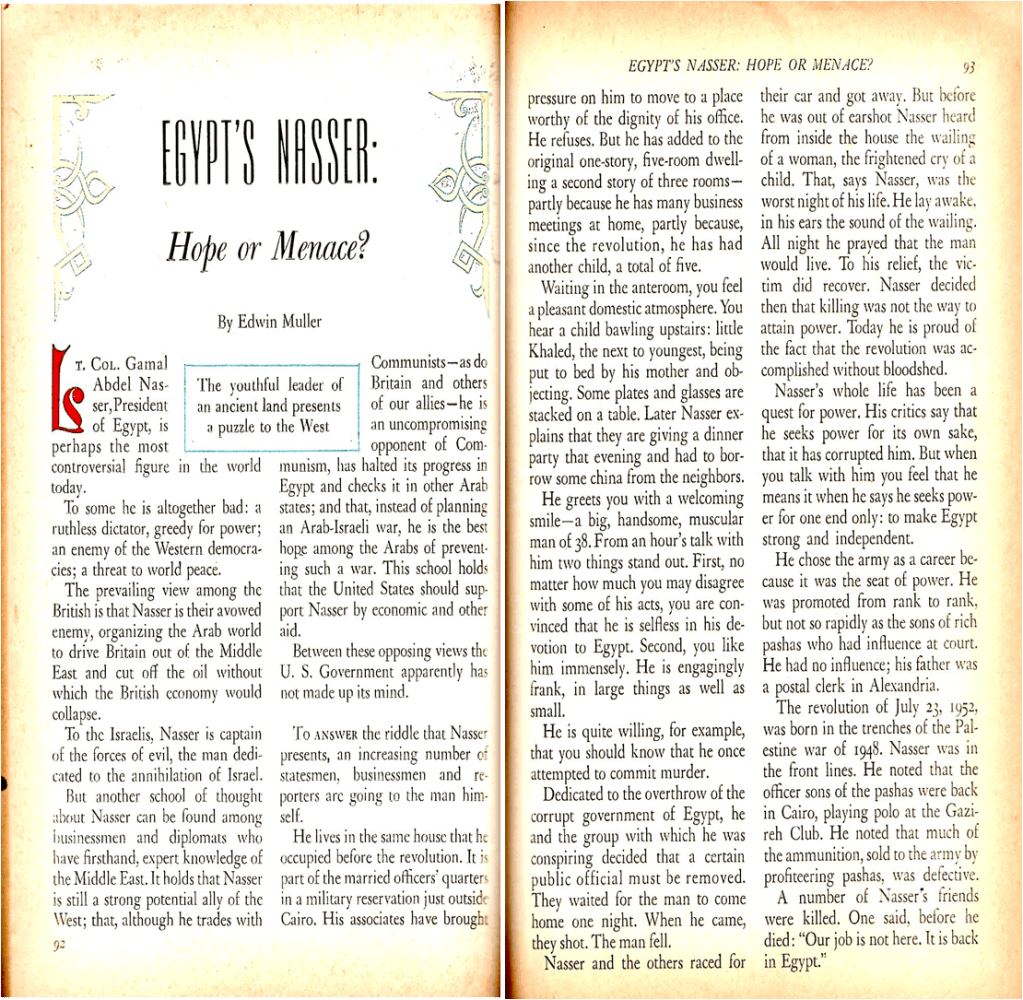
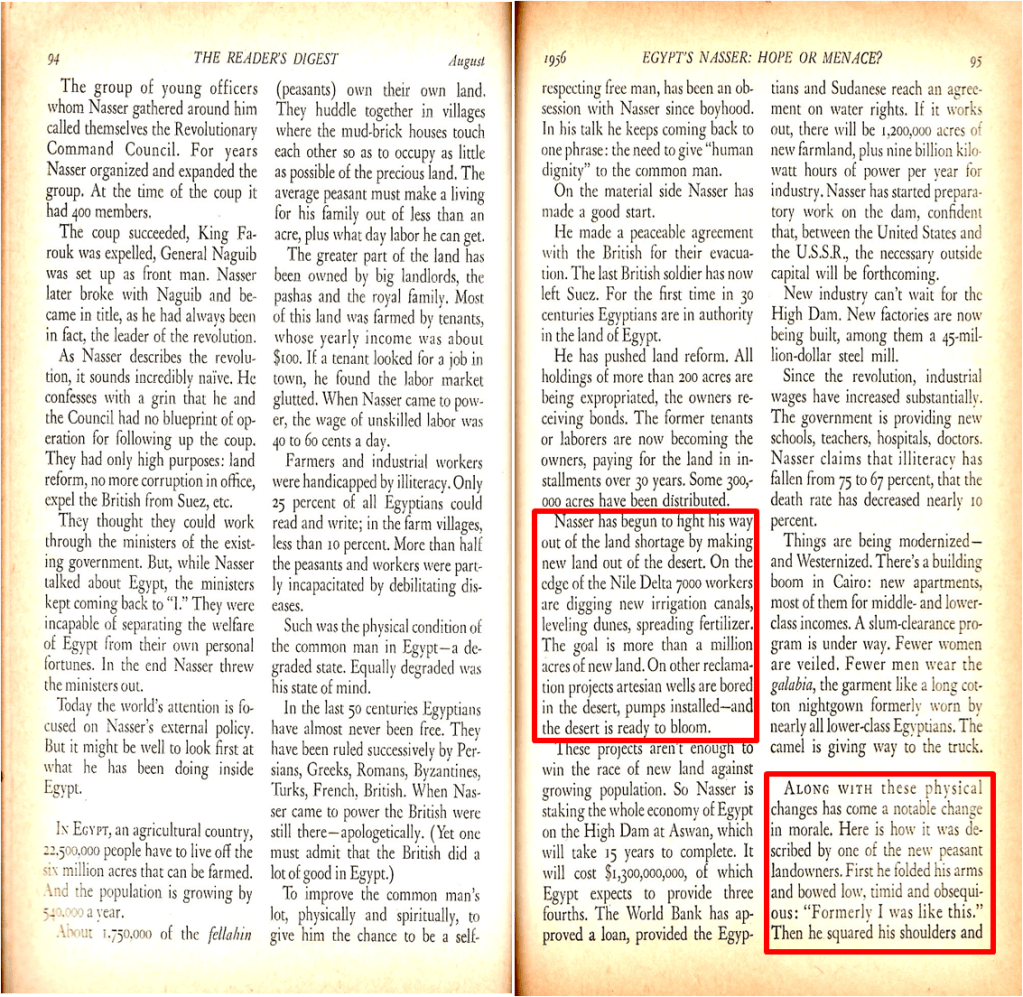
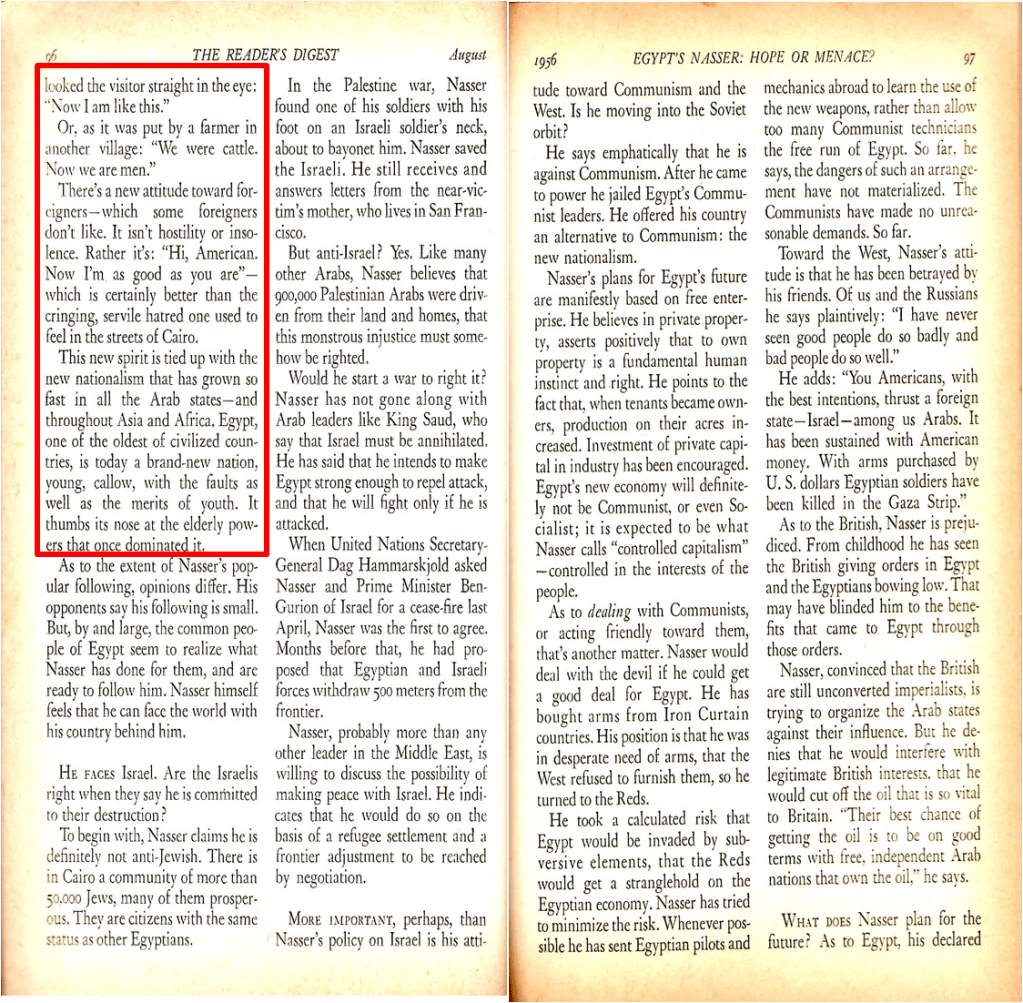
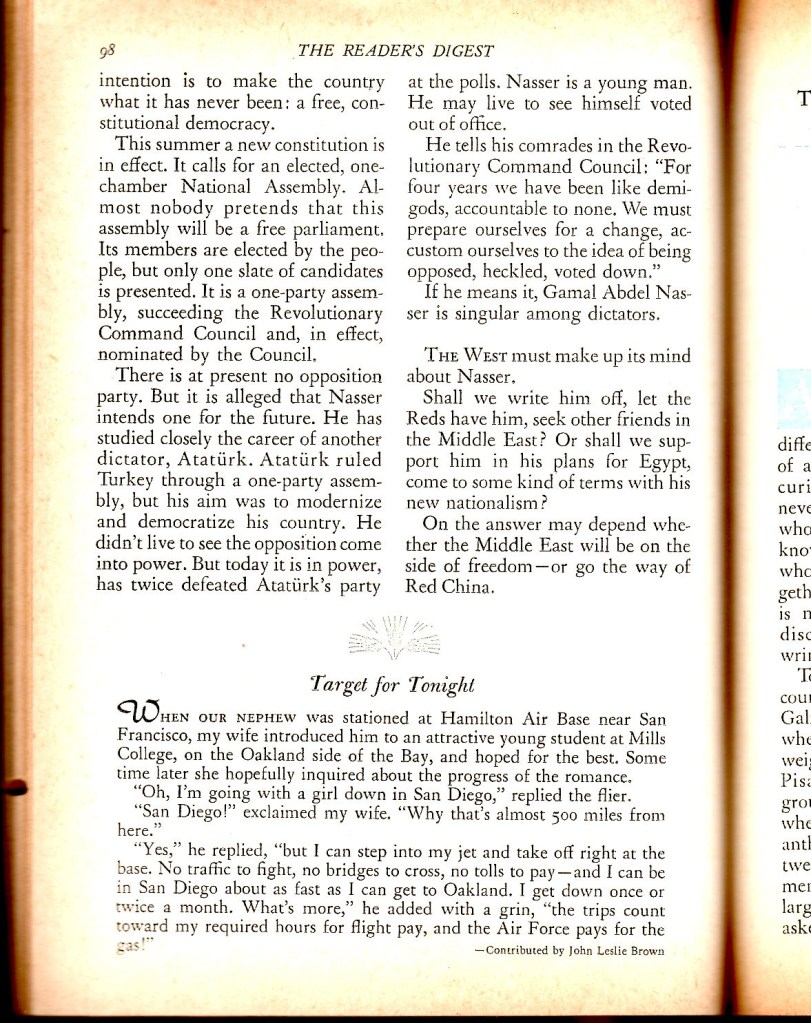
I have highlighted two portions of the articles. The first describes the many civil engineering projects which were implemented by Nasser with the goal of improve the lives of ordinary Egyptians through advancements in agriculture and improved access to electricity. The proposed Qattara Depression Project fell within this broad class of public works.
1. “Nasser has begun to make his way out of the land shortage by making new land out of the desert. On the edge of the Nile Delta 7,000 workers are digging new irrigation canals, leveling dunes, spreading fertilizer. The goal is more than a million acres of new land. On other reclamation projects artesian wells are bored in the desert, pumps installed – and the desert is ready to bloom.”
The second describes the sense of empowerment brought about by the influence of colonial reign.
2. “Along with these physical changes has come a noticeable change in morale. Here is how it was described by one of the new peasant landowners. First he folded his arms and bowed low, timid and obsequious: ‘Formerly, I was like this.’ Then he squared his shoulders and looked the visitor straight in the eye: ‘Now I am like this.’
Or, as it was put by a farmer in another village: ‘We were cattle. Now we are men.’
There’s a new attitude toward foreigners- which some foreigners don’t like. It isn’t hostility or insolence. Rather, it’s: ‘Hi, American. Now I’m as good as you are.’ – which is certainly better than the cringing, servile hatred one used to feel in the streets of Cairo.
This new spirit is tied up with the new nationalism that has grown so fast in all the Arab states- and throughout Asia and Africa. Egypt, one of the oldest of civilized countries, is today a brand-new nation, young, callow, with the faults as well as the merits of youth. It thumbs its nose at the elderly powers which once dominated it.”
***
According to sources (https://www.wikiwand.com/en/Qattara_Depression is the most readily available and is quoted below) the Qattara Depression Project was proposed as follows:
“In 1957, the American Central Intelligence Agency proposed to President Dwight Eisenhower that peace in the Middle East could be achieved by flooding the Qattara Depression. The resulting lagoon, according to the CIA, would have four benefits:
(1) it is easier to extract oil from offshore platforms than in swamps
(2) the flow will turn the hydroelectric power station
(3) fishing, resorts, pearls
(4) It would get Egyptian president Gamel Abdel Nasser’s ‘mind on other matters’ because ‘he need[ed] some way to get off the Soviet hook’”
The source continues:
“In the 1970s and early 1980s, several proposals to flood the area were made by Friedrich Bassler and the Joint Venture Qattara, a group of mainly German companies. They wanted to make use of peaceful nuclear explosions to construct a tunnel, drastically reducing construction costs compared to conventional methods. This project proposed to use 213 Hydrogen bombs, with yields of one to 1.5 megatons, detonated at depths of 100 to 500 metres (330 to 1,640 ft). That fit within the Atoms for Peace program proposed by US President Dwight D. Eisenhower in 1953. The Egyptian government turned down the idea.”
I suppose we might accept these statements at face value, combine them, and take away the lesson that peace in the Middle East is achievable through the detonation of 213 hydrogen bombs. Let us instead explore the underlying circumstances which surrounded President Nasser, President Eisenhower’s Atoms for Peace Program, and the Soviet Union in the post WWII era.
***
President Eisenhower’s farewell address on 17 January 1961 is well-known and often cited, especially the line in bold [added here, from https://www.archives.gov/milestone-documents/president-dwight-d-eisenhowers-farewell-address ].
“A vital element in keeping the peace is our military establishment. Our arms must be mighty, ready for instant action, so that no potential aggressor may be tempted to risk his own destruction. . . . American makers of plowshares could, with time and as required, make swords as well. But now we can no longer risk emergency improvisation of national defense; we have been compelled to create a permanent armaments industry of vast proportions. . . . This conjunction of an immense military establishment and a large arms industry is new in the American experience. . . .Yet we must not fail to comprehend its grave implications. . . . In the councils of government, we must guard against the acquisition of unwarranted influence, whether sought or unsought, by the military-industrial complex. The potential for the disastrous rise of misplaced power exists and will persist.”




 NEWSPASTE